

October 16, 2026 | Innovation
Predicting Spare Parts Demand with Machine Learning for a Scientific Instrumentation Leader
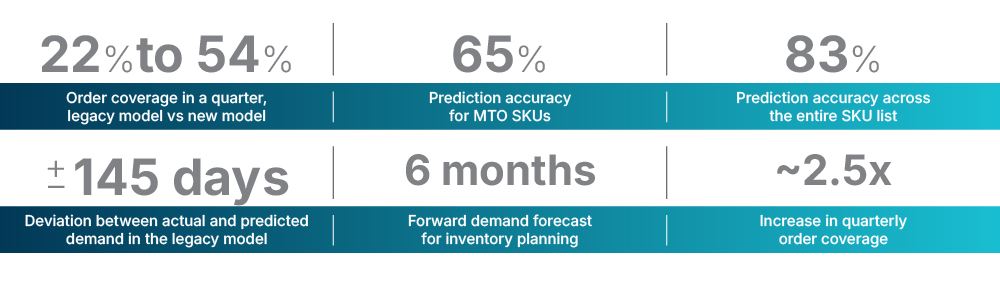
How Netscribes replaced a legacy forecasting system with a low-cost machine learning model that predicts when spare parts will be needed, raising quarterly order coverage from 22% to 54% and helping reduce excess and obsolete inventory.
 The Challenge
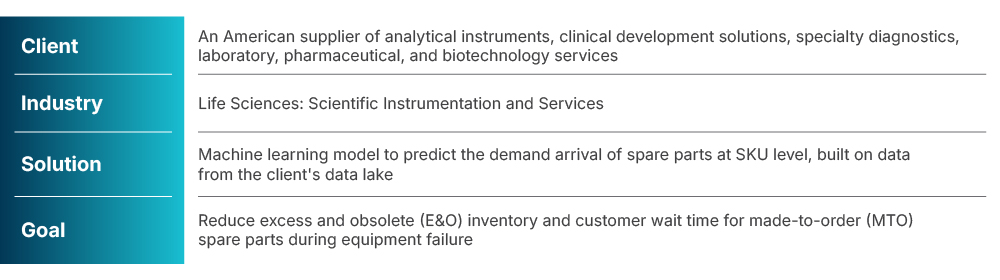
When scientific equipment fails, customers need spare parts quickly. The client wanted to predict each piece of equipment's mean time between failures (MTBF) so it could anticipate when demand for spare parts would arrive.
The business was dealing with high excess and obsolete (E&O) inventory, a need to reduce inventory overall, and long order service times for made-to-order spare parts.
Its legacy forecasting system had clear limits. Predicted demand could deviate from actual demand by as much as 145 days in either direction, and the model covered only 22% of orders in a quarter.
Our Approach
Netscribes replaced the legacy forecasting system with a low-cost machine learning model that predicts the demand arrival of spare parts.
- Used data from the client's data lake as the input to a predictive module that forecasts reordering at SKU level.
- Built a predictive model to identify MTO SKUs whose next demand date can be predicted with reasonable accuracy, so they can be ordered in advance.
- Produced quarterly projections to guide order fulfillment and minimize excess and obsolete inventory.
- Forecast demand six months ahead to maintain appropriate inventory and supply levels.
The Impact
The new model gave the client a more accurate, forward-looking basis for stocking and ordering spare parts.
What did this mean for the scientific instrumentation supplier?
For a supplier whose customers depend on laboratory and diagnostic equipment, customer wait time for spare parts during equipment failure matters. By predicting when spare parts demand would arrive, the client could determine optimal inventory levels that balance demand and stock, and fulfill orders based on quarterly projections. Six-month forecasts helped maintain appropriate supply levels while reducing costs, waste, and excess and obsolete stock. Proactively identifying potential issues shortened customer wait times, leading to increased customer satisfaction.
Day-to-day Change After Go-live
Instead of relying on a legacy forecast that covered only 22% of quarterly orders, the client now plans spare parts inventory using SKU-level predictions drawn from its data lake. MTO SKUs whose next demand date can be predicted are ordered in advance, and inventory is planned against a six-month demand forecast.
Ready to predict demand more accurately and optimize spare-parts inventory? Explore our Applied AI & Automation capabilities.
Innovation
Custom Machine Learning for Sharper Sales Forecasts for an Automotive Manufacturer


Engineering
Keeping Pace with Connected Vehicle Data: Telematics Platform Modernization for a Leading Automotive Manufacturer
We respect your privacy. You may unsubscribe anytime.Privacy Policy.