

October 22, 2026 | Engineering
Keeping Pace with Connected Vehicle Data: Telematics Platform Modernization for a Leading Automotive Manufacturer
How Netscribes re-engineered a legacy telematics architecture into a scalable, Databricks-enabled data platform for EV and connected vehicles, reducing data processing latency by 60% and cutting breakdown incidents by 22% through predictive maintenance.
The Challenge
The client's existing telematics platform was unable to support rising data volumes from its new EV and connected models. Legacy data pipelines limited real-time insights and over-the-air (OTA) capability, restricting the client's ability to deliver intelligent vehicle experiences.
Batch-processing pipelines created high data latency, delaying driver behavior insights and predictive maintenance models. Legacy systems also lacked the flexibility needed for remote diagnostics and firmware updates.
At the same time, disparate cloud and on-premises systems lacked a unified processing and governance model, adding hybrid cloud complexity.
Our Approach
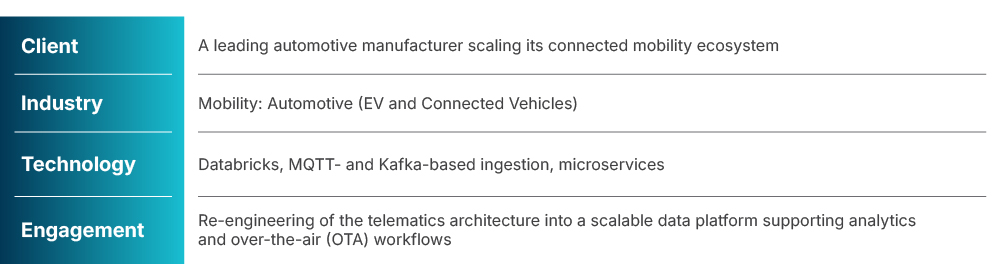
Netscribes re-engineered the telematics architecture into a scalable, Databricks-enabled data platform supporting analytics and OTA workflows.
- Databricks-based data engineering: unified streaming and batch pipelines for real-time telemetry processing.
- Event-driven architecture: implemented MQTT- and Kafka-based ingestion for high-frequency EV sensor data.
- OTA enablement: built a secure microservices layer for diagnostics, firmware delivery, and vehicle health monitoring.
The Impact
The re-engineered platform delivered real-time analytics, enhanced OTA capability, improved vehicle uptime, and a future-ready architecture.
 What did this mean for the automotive manufacturer?
For an automotive manufacturer scaling its connected mobility ecosystem, the new platform reduced data processing latency by 60%, enabling actionable insights. Predictive maintenance reduced breakdown incidents by 22%, improving vehicle uptime. Enhanced OTA capability enabled faster deployment of software patches and feature enhancements, and the scalable platform supports upcoming EV and connected variants.
Day-to-day Change After Go-live
Telemetry is now processed in real time through unified streaming and batch pipelines on Databricks, with MQTT- and Kafka-based ingestion for high-frequency EV sensor data. Diagnostics, firmware delivery, and vehicle health monitoring run through a secure microservices layer.
Ready to modernize connected-vehicle data and build a scalable telematics platform? Explore our Engineering for Scale capabilities.
Innovation
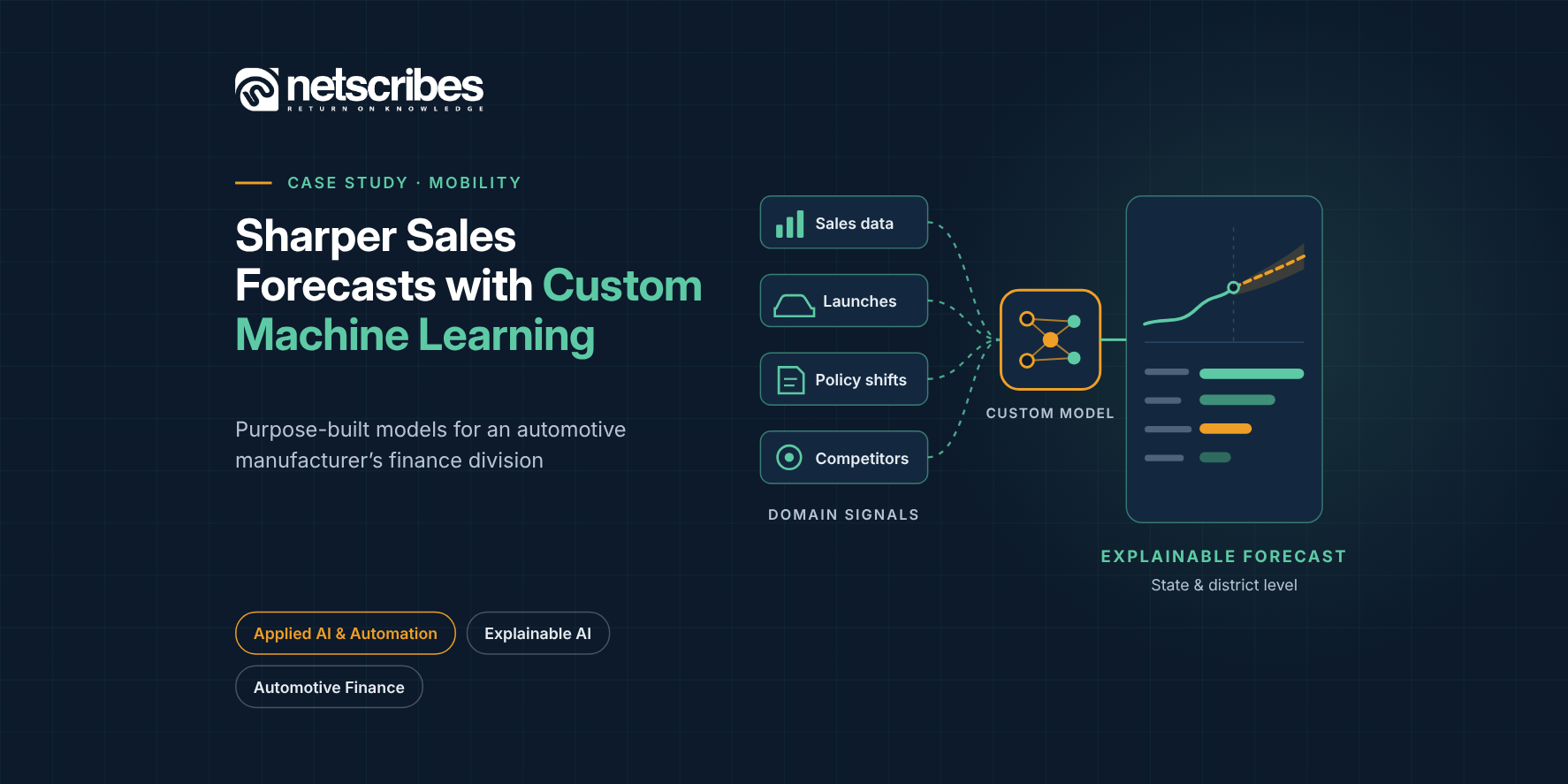
Custom Machine Learning for Sharper Sales Forecasts for an Automotive Manufacturer


We respect your privacy. You may unsubscribe anytime.Privacy Policy.