

September 15, 2026 | Engineering
From Data Warehouse to Lakehouse: Modernizing Analytics for a Multi-brand Fashion Retailer
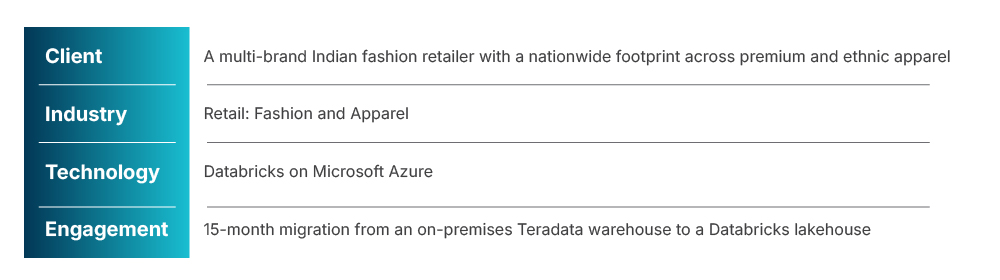
How Netscribes helped an Indian fashion retail group move from an on-premises Teradata warehouse to a governed Databricks Lakehouse on Microsoft Azure, reducing costs, accelerating data processing, and creating a foundation for advanced analytics and AI.
The Challenge
The retailer’s analytics depended on an on-premises Teradata warehouse that was reliable for standard reporting but increasingly difficult to scale as the business expanded across brands, channels, and technology environments.
Data from Azure, AWS, ERP, and on-premises systems remained separated by source. Accessing it often required support from multiple teams, creating dependencies before analysts could begin working with the data. Multi-layer processing also introduced latency into ETL workflows, delaying the movement of data from source systems into reporting.
Once the data became available, weak discovery, lineage, and business-glossary capabilities made it difficult for users to find the right datasets and determine whether they could trust them. Access controls also varied across systems, making governance harder as the data estate expanded.
The result was a slower analytics workflow in which teams spent too much time locating, accessing, processing, and validating data before they could use it. The existing warehouse was also limited to structured data and SQL-based business intelligence, leaving the retailer without a scalable foundation for machine learning, AI, or streaming use cases.
Our Approach
Netscribes led the migration from Teradata to a Databricks lakehouse integrated with the retailer's existing Microsoft Azure environment. Databricks was selected over alternatives such as Azure Synapse for its cost-effective governance, architectural flexibility, and lower risk of ecosystem lock-in.
- Designed a Medallion Architecture spanning Landing, CDC, Bronze, Silver, Gold, and Reporting layers.
- Shortlisted Azure Data Factory for historical and incremental data integration, change data capture, ETL orchestration, and automated alerts.
- Built a reusable Delta Live Tables framework using dynamic PySpark and parameterized ADF pipelines.
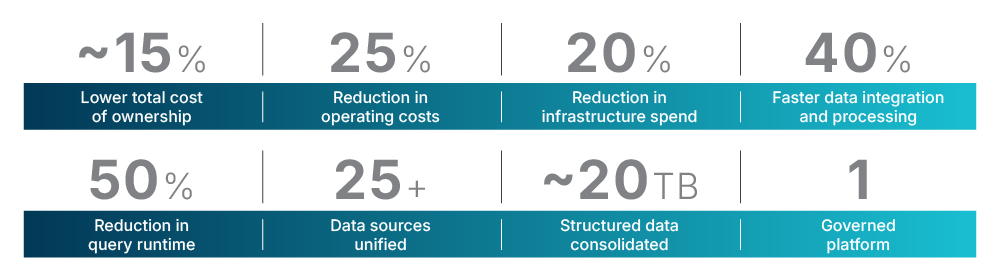
- Integrated more than 25 data sources and approximately 20 TB of structured data across Azure, AWS, ERP, and on-premises platforms.
- Centralized data governance, cataloging, lineage, glossary access, and fine-grained permissions through Unity Catalog.
- Connected Power BI directly to the platform and optimized storage and query performance as data volumes grew.
- Established CI/CD through Azure DevOps and introduced daily data-reconciliation dashboards using custom SQL.
The Impact
The 15-month migration replaced a patchwork of siloed systems with one governed platform and delivered measurable gains in cost, speed, and scale.
What did this mean for the fashion retailer?
For this multi-brand fashion retailer, the transition created one reliable view of data across its brands, products, channels, and business systems. Instead of depending on multiple specialists to locate and reconcile information from different sources, teams could work from governed, validated data on a shared platform. Faster processing and query performance meant that product, sales, inventory, and customer data could be analysed sooner, while daily reconciliation dashboards helped ensure that the numbers being used were accurate. In a business where demand shifts quickly and every style, size, colour, and channel generates another layer of data, this gives teams a faster and more dependable foundation for making retail decisions
Day-to-day Change After Go-live
The retailer now operates analytics on one governed platform rather than a collection of source-dependent systems. Daily reconciliation dashboards help teams validate data quality and key metrics consistently, while catalog, lineage, and glossary capabilities make datasets easier to discover and understand. Centralized controls support safer collaboration across functions, and the lakehouse provides a governed foundation for future machine learning, AI, and real-time streaming use cases.
Innovation
Custom Machine Learning for Sharper Sales Forecasts for an Automotive Manufacturer

Engineering
Keeping Pace with Connected Vehicle Data: Telematics Platform Modernization for a Leading Automotive Manufacturer
We respect your privacy. You may unsubscribe anytime.Privacy Policy.