

According to IDC research cited in Databricks' own Big Book of Data Engineering, approximately “41% of organizations say their data is changing faster than they can keep up with it.”
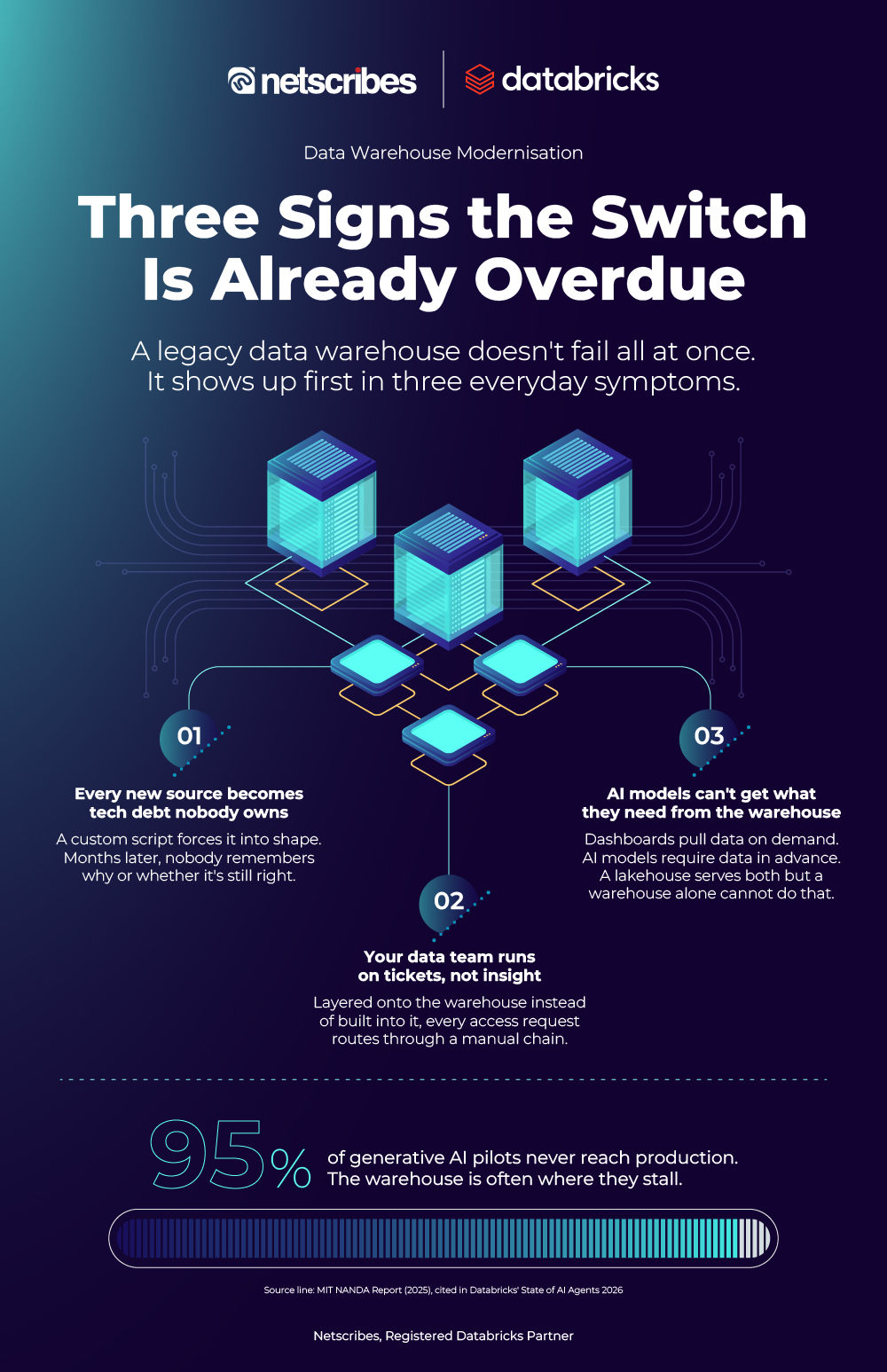
For a CDO running a warehouse that was built ten or fifteen years ago, that number rarely shows up as a single dramatic event. There's no outage, no headline, no board-level incident report. Instead, the cost shows up in small, recurring ways: a new integration that takes six weeks instead of six days, an analytics request that waits behind a queue of access approvals, a machine learning project that quietly slips its launch date for the third time. Each one looks like a minor operational hiccup. Together, they are the warehouse charging you rent you didn't budget for.
This is the problem a lakehouse migration is meant to solve, not by adding another tool to the stack, but by giving data, analytics, and AI a single governed home instead of a growing pile of disconnected systems.
Why the cost is quiet instead of loud
Part of what makes this expensive is that none of it looks like a crisis. ISG predicts that “by 2026, eight in ten enterprises will have their data spread across multiple cloud providers and on-premises systems spanning several locations”. A warehouse that was designed for one or two systems of record is now expected to absorb data from a dozen SaaS tools, a handful of clouds, and whatever new source the business signs up for next quarter. It still runs. It still returns query results. What it no longer does well is keep pace, and that gap between "still working" and "still working well" is exactly where the quiet costs accumulate.
What actually needs to happen
Moving off a legacy warehouse isn't a single cutover, and treating it like one is usually how these projects stall. It works better as a staged process:
- Map what you actually have. Before anything moves, get an honest inventory of every pipeline, script, and access rule currently running, including the ones nobody remembers building. You cannot retire what you haven't found.
- Consolidate onto one governed platform. Instead of a warehouse for reporting, a separate lake for raw data, and a bolt-on tool for AI, a lakehouse gives all three the same governed foundation, so a rule set applied once for data access applies everywhere, not per-system.
- Migrate in stages, not a single leap. Move the highest-friction workloads first (usually the ones generating the most support tickets or blocking the most AI work), prove the new environment on those, then expand.
- Retrain the team so the patchwork doesn't come back. A new platform run with old habits (one-off scripts, undocumented access exceptions) will eventually recreate the exact problem it replaced. The migration isn't finished until the people running it day to day are comfortable doing so differently.
Where the quiet costs actually show up
 Governance and change management matter more than the technology
None of this works if it's treated as a pure infrastructure swap. The teams that get the most out of a lakehouse migration treat governance and training as part of the project, not an afterthought once the new platform is live:
- Design access rules once, not per team. The goal is a single, auditable rule set that applies everywhere data lives, not a fresh set of exceptions for every new project.
- Retrain before go-live, not after. Teams that keep working the old way on the new platform tend to rebuild the same patchwork within a year.
- Migrate the highest-friction workloads first. Early wins build the internal case for finishing the migration properly, rather than stalling halfway with two systems running in parallel indefinitely.
How Netscribes helps
Netscribes works alongside enterprise data teams on the part of a lakehouse migration that a platform alone doesn't solve: auditing what's actually running today, migrating pipelines and access rules in a sequence that doesn't disrupt reporting the business depends on, and retraining the people who'll run the platform once the migration team leaves. Netscribes also operates Databricks environments as an ongoing managed service for clients who'd rather not carry the full cost of an in-house specialist team, which internal estimates put at roughly 40 to 60% cheaper than staffing the equivalent expertise in-house (a directional, internal estimate rather than an audited external benchmark, worth treating as a starting point for your own cost comparison rather than a guaranteed figure).
If pipeline sprawl, a growing access-ticket queue, or a stalled AI roadmap sound familiar, it's worth having the lakehouse conversation before the next quarter's data source makes the problem a little bit worse. Talk to Netscribes about a lakehouse migration to see what a staged move off your current warehouse could look like.
FAQs
1. How much does a lakehouse migration cost?
There's no standard price. Cost depends on how many pipelines, data sources and access rules have to move, how much undocumented logic needs to be rebuilt, and how far the migration is staged. A useful business case weighs that cost against what the current warehouse already costs in maintenance time, access backlogs and stalled AI work.
2. Databricks vs Snowflake: which is better for a lakehouse?
Both now support lakehouse-style architectures and open table formats. They come from different starting points. Databricks grew out of data engineering and machine learning, and Snowflake out of cloud data warehousing. The better fit depends on the balance between SQL analytics and AI/ML work, the skills already on your team, governance needs, and how costs scale with your usage.
3. How long does a lakehouse migration take?
It depends on scope. Inventorying existing pipelines and moving the first high-friction workloads can often happen within weeks. Migrating the full estate, retiring the old warehouse and retraining teams usually takes months. A staged approach delivers early wins along the way, so the business doesn't wait for one big cutover to see value.


