Go-to-market decisions determine where marketing money gets spent, which audiences get prioritized, and how quickly a new product gains traction. When those decisions are based on assumptions rather than validated data, budgets can be spread across the wrong markets, channels, customer segments, or price points, and the impact can show up almost immediately after launch.
Go-to-market intelligence provides the research and data layer needed to make those decisions with greater precision. By bringing together market sizing, competitive intelligence, and consumer research, it helps teams identify where to enter, who to target, how to price, and where marketing investment is most likely to generate returns. The difference between assumption-led and intelligence-led GTM is ultimately a difference in how efficiently capital is deployed: one relies on hunches, while the other directs spend toward the opportunities backed by evidence.
The assumptions that kill GTM strategies before they start
Every failed launch has a moment, months before the failure, where someone decided a guess was good enough. The customer segment gets defined by whatever demographic fields sit in the CRM, age, income bracket, region, because that's the data on file, not because it's the data that predicts who actually buys.In a rapidly evolving and volatile environment, where market dynamics changing every month, past knowledge is getting dated soon. Competitive analysis means someone scrolled through five competitor websites and built a feature comparison table, which tells you what competitors say about themselves, not what's actually winning share on the ground. Pricing gets set by cost-plus math, margin target applied to production cost, with no read on what the market will actually pay for it.
None of these inputs are irrational. They're what's available, fast, and defensible in a room where someone is asking for a launch date. That's exactly the problem: they're defensible, not accurate. A strategy built on defensible-but-wrong inputs still fails; it just fails with a paper trail.
The geography mistake most GTM strategies make
There's a specific failure pattern in market entry: companies expand into markets where competitors have already gone, because a market with three incumbents feels validated. Someone else did the diligence, the logic goes, so the risk is lower.
It's the opposite. A market with three entrenched incumbents is a market with three companies actively defending share, pricing to hold it, and watching for exactly the kind of new entrant that's about to show up. Validated markets are defended markets. The entry cost is higher, the timeline to profitability is longer, and the "safe" choice is often the most expensive one.
The markets worth entering are usually the ones nobody's pitching in the boardroom, where demand is real but competitors are overextended, under-resourced in that specific geography, or simply not there yet. Finding that gap is what whitespace analysis is built for. It's also the part of GTM research that gets skipped most often, because it requires making a case for a market nobody in the room has heard mentioned before.
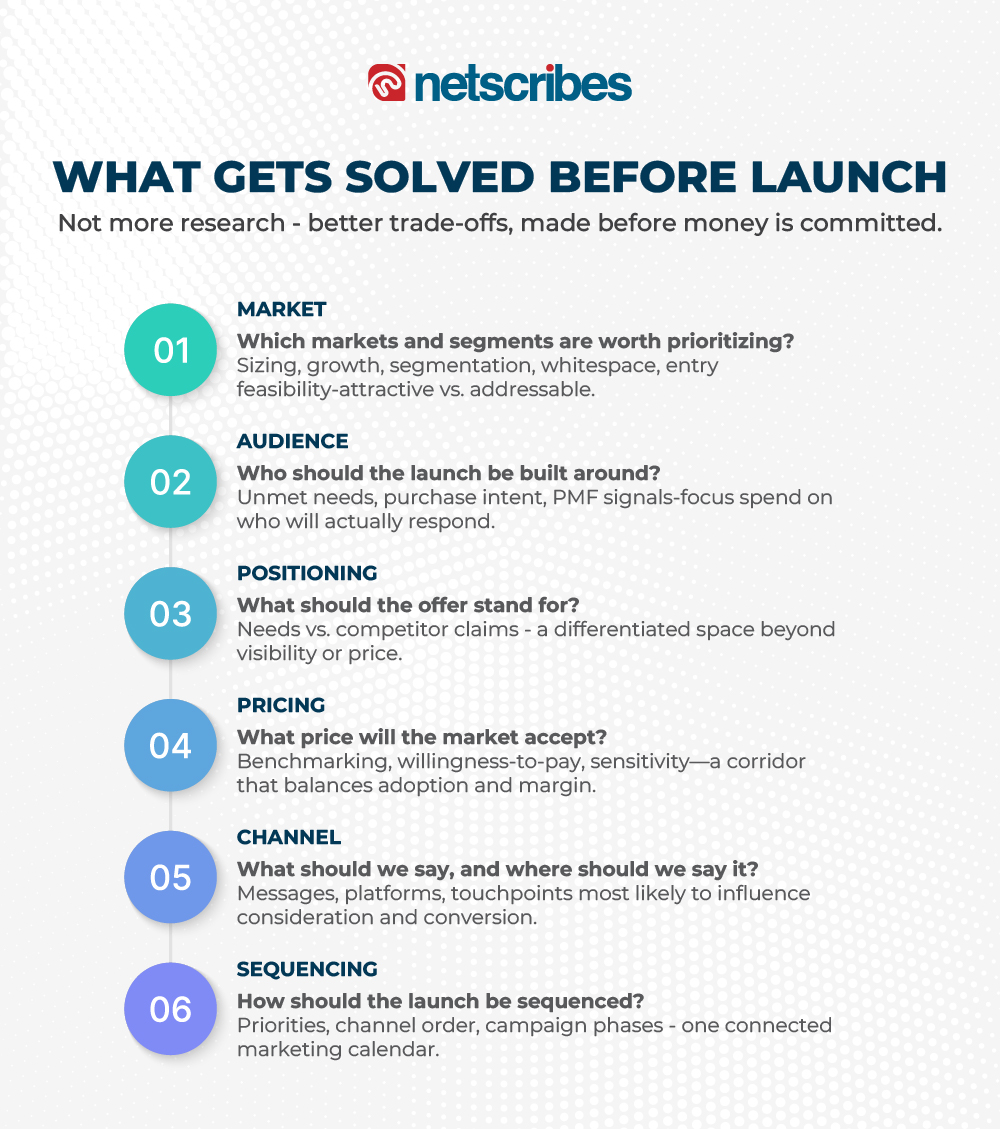
What GTM intelligence helps you solve before launch
Before launch, the challenge is rarely a lack of data. It is knowing which decisions deserve investment, which assumptions need validation, and where limited marketing resources will have the highest impact. GTM intelligence helps answer those questions across the decisions that shape commercial success.
-
Which markets and segments are worth prioritizing?
Market landscape understanding combines category sizing, growth trends, customer segmentation, competitive activity, whitespace analysis, and entry feasibility to identify where the strongest opportunities actually exist. It helps teams distinguish attractive markets from addressable ones and prioritize the segments where they have a realistic right to win.
-
Who should the launch be built around?
Consumer insights and voice of customer research help identify the audiences with the strongest unmet needs, purchase intent, and product relevance. Methods such as concept testing, need-state analysis, and product-market fit research help teams focus acquisition spend on customers most likely to respond rather than spreading budgets across broad demographic assumptions.
-
What should the offer stand for?
Positioning research evaluates customer needs alongside competitor propositions to identify a differentiated space for the product. It helps determine which benefits to lead with, which claims are credible, and how the proposition should be framed so the launch competes on something more meaningful than visibility or price alone.
-
What price will the market accept?
Pricing intelligence combines competitor benchmarking, willingness-to-pay research, price sensitivity analysis, and value perception to establish a viable pricing corridor. This helps teams balance adoption, margin, and positioning instead of setting price primarily from internal cost structures or competitor averages.
-
What should we say, and where should we say it?
Communication and channel analysis identify the messages, platforms, and customer touchpoints most likely to influence consideration and conversion. This gives marketing teams a stronger basis for allocating spend across channels and developing communication around evidence of what matters to the audience rather than internal assumptions.
-
How should the launch be sequenced?
The research can then be translated into an actionable launch plan, including market and audience priorities, channel sequencing, campaign phases, and a marketing calendar. This connects intelligence to execution and helps teams concentrate resources around the moments and activities most likely to move demand.
The value of GTM intelligence, therefore, is not simply producing more research. It is helping teams make better trade-offs before money is committed: which market to enter, which audience to prioritize, how to position and price the offer, where to distribute it, and which marketing levers deserve the greatest share of investment.
What intelligence-led GTM looks like in practice, a real example
For one flavored milk brand evaluating entry into the Russian market, the initial question was straightforward: which consumers should it target, and at what price?
The research went well beyond validating the existing launch assumptions. More than 6,000 consumers were surveyed across 13 markets, supported by 70 expert interviews to understand category dynamics, purchasing behaviour, competitive positioning, and willingness to pay.
The most valuable finding was a consumer segment that the original GTM plan had underweighted. This group showed stronger purchase intent for flavored milk, but its willingness to pay and preferred proposition differed from the audience the brand had initially planned to target. That insight changed both the priority segment and the pricing approach, revealing a potential 10–15% revenue growth opportunity that was not visible in the original plan.
That is where intelligence changes the outcome of a launch. It does not simply confirm whether an existing strategy looks reasonable. It can uncover a more attractive customer segment, expose a pricing opportunity, identify a stronger positioning territory, or show that marketing investment should be concentrated somewhere entirely different.
The value is in finding those insights before budgets are committed, distribution is locked in, and the launch calendar is already in motion.
How to choose the right go-to-market research firm
Not every GTM strategy research company is set up to answer the questions above. A few things separate the ones that are.
Primary and secondary research combined, not one or the other. Secondary data tells you what's already been published; primary research tells you what's actually happening in the market right now. A firm that only does one is only answering half the question.
Industry depth that goes beyond a generic research template. A firm that's run hundreds of GTM studies inside your specific vertical asks different questions and knows which answers to distrust, compared with one running its first.
Speed to insight. A six-month research timeline against a launch window that's already been set publicly is research that arrives too late to change anything.
The ability to operate across geographies with local fieldwork, not desk research translated into a different currency. Market entry research done from a desk two continents away misses the on-the-ground signal that primary fieldwork catches.
The real cost isn't the research budget
The cost of skipping GTM research was never the research line item. It's the failed launch, the wrong geography, the eighteen-month pivot that follows it, the cost of finding out in-market what a research phase would have found out first.
Talk to our GTM research team about what intelligence-led go-to-market planning looks like for your next launch.
FAQs
1. Why do most go-to-market strategies fail?
Most fail because the plan is built once and never revisited as market conditions change. Competitors react, buyer sentiment shifts, and channels perform differently than assumed but the original plan stays fixed, so problems go undetected until a scheduled review, by which point real budget and time are already lost.
2. What does "intelligence-led" GTM mean, and how is it different from a traditional GTM strategy?
Traditional GTM is a static plan decided once before launch. Intelligence-led GTM keeps monitoring market and competitive signals throughout execution, so the plan can be adjusted based on real response, not just reviewed on a fixed quarterly schedule.
3. What is go-to-market intelligence?
It's the practice of combining upfront market and competitive research with continuous monitoring through execution, market sizing, competitor pricing, channel performance, and buyer signals, so the GTM plan can be refined in near real time, not just at the next scheduled review.
4. What signals should an intelligence-led GTM strategy monitor after launch?
Competitor pricing and positioning shifts, brand perception changes, brand funnel performance, communication performance. Usage behaviour. Moments of usage (for FMCG goods), channel performance versus pre-launch assumptions, buyer objection patterns from real sales conversations, and category-level demand changes that might mean the original market sizing needs revisiting.
5. How do you build a GTM strategy that adapts instead of failing quietly?
Separate the plan's core assumptions from its actions so you know exactly what to monitor. Tie reviews to real signal changes, not just a calendar date, a quarterly-only review means a broken assumption from week two goes uncaught for months