

Every enterprise has data moving somewhere, from a sales system into a dashboard, from a warehouse into a report, from a dozen disconnected tools into whatever spreadsheet someone has to update by hand every Monday morning. Most leaders assume this movement is automatic, reliable, and invisible. In reality, it is held together by a data pipeline that was probably built for a much smaller, simpler version of the business than the one it now serves.
What is a data pipeline?
A data pipeline is a set of automated steps that move data from its source (a sales system, an app, a sensor, a database) to a destination where it can be used (a dashboard, a report, an analytics tool, another application), transforming it along the way so it arrives clean, structured, and usable. Think of it as plumbing for information: water (data) enters at one end, travels through a series of pipes and filters (processing steps), and comes out the other end ready to drink (ready to analyze).
What a data pipeline is, in plain language
Strip away the engineering vocabulary and a data pipeline does three things, in order.
First, it collects data from wherever that data originates. This could be a CRM, a payment processor, a set of IoT sensors, or a legacy internal system nobody remembers building.
Second, it transforms that data. Raw data is almost never usable as-is. It has duplicate records, missing fields, inconsistent formats (one system logs a date as "03/04/2026," another as "2026-04-03"), and needs to be cleaned, standardized, and often combined with data from other sources.
Third, it delivers the data somewhere useful. That destination might be a data warehouse, a business intelligence dashboard, a machine learning model, or another downstream application.
Why does this matter to someone who isn't an engineer?
Because every report a business leader trusts, every dashboard a team checks each morning, and every automated decision a system makes downstream all depend on this plumbing working correctly. When a pipeline breaks or silently produces bad data, the failure doesn't announce itself. It shows up three weeks later as a board member asking why the revenue number in the quarterly deck doesn't match finance's own numbers.
The anatomy of a production-grade data pipeline
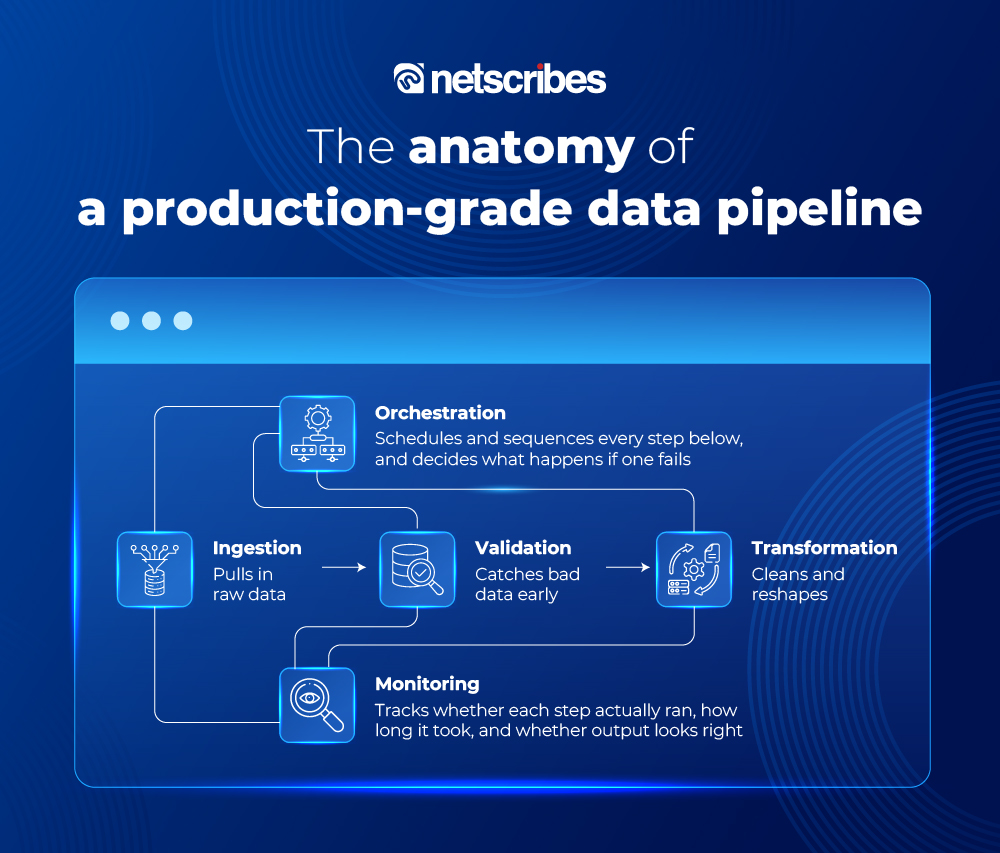
A pipeline that survives contact with the real world has a few components that a quick prototype usually skips.
- Ingestion. How data enters the pipeline in the first place, whether that's a live feed, a scheduled batch pull, or an event triggered by something happening elsewhere in the business.
- Validation. Checks that catch bad data before it moves further downstream. Did a required field come through empty? Did a number that should always be positive come through negative? Validation is the difference between a pipeline that fails loudly and one that fails silently.
- Transformation. The cleaning, standardizing, and reshaping of data so it's consistent and usable once it lands.
- Orchestration. The scheduling and sequencing logic that decides when each step runs and what happens if one step fails. This is often the least visible part of a pipeline and the part most likely to cause quiet, compounding problems when it's an afterthought.
- Monitoring. Visibility into whether the pipeline actually ran, how long it took, and whether the output looks the way it's supposed to. Without this, most teams find out about a broken pipeline from an angry stakeholder rather than from the system itself.
Most teams build ingestion and transformation first, because that's the part that produces a visible result. Validation, orchestration, and monitoring get added later, usually after something has already gone wrong.
The difference between a good pipeline and a working pipeline
A pipeline can run successfully and still be wrong for the business. This is the distinction most non-technical stakeholders miss, and it is the single biggest source of frustration between business teams and engineering teams.
A working pipeline moves data from A to B without crashing. A good pipeline moves data from A to B, catches bad data before it spreads, recovers gracefully when something upstream changes, and gives someone a way to know it did its job correctly. A pipeline that "works" in the sense that it doesn't throw an error can still quietly corrupt a report, double-count a customer, or drop rows without anyone noticing for months.
This is why "it's running fine" is not the same question as "is it right." Teams that only monitor whether a pipeline executed, rather than whether its output is correct, tend to discover data quality problems the hard way: when a number that mattered turns out to have been wrong for a long time.
The five ways enterprise data pipelines break (and what to do about each)
- Schema drift. A source system changes, a field gets renamed, a data type changes from text to number, a new field gets added upstream, and the pipeline wasn't built to notice. It keeps running, but the data coming out no longer means what everyone assumes it means. The fix is building schema validation into the pipeline itself, so a structural change upstream triggers an alert instead of a silent shift in meaning.
- Volume that outgrows the design. A pipeline built and tested against a small sample of data can behave very differently once real production volume hits it. Jobs that finished in minutes during testing start taking hours, batch windows get missed, and downstream reports arrive late or incomplete. This is one of the most common and least obvious traps in data engineering: a pipeline that passes every test in a development environment can still fail in production, not because the logic is wrong, but because the assumptions about data volume, load timing, or system load simply don't hold at real-world scale. What looks like a clean, working pipeline in a controlled test can quietly grind to a halt (or silently drop records) the first time it meets a full production dataset. The fix is designing and load-testing pipelines against realistic production volumes from the start, not against a convenient sample.
- Silent failures. A step in the pipeline fails, but instead of stopping and raising an alert, it skips the problem and keeps going, sometimes producing partial or incorrect output that looks complete. Nobody finds out until someone downstream asks why a number looks off. The fix is building pipelines to fail loudly. A pipeline that stops and alerts someone is far less costly than one that quietly keeps producing bad data.
- Dependency chains nobody mapped. As pipelines grow, one dataset starts depending on another, which depends on another, and eventually a change in one small upstream process breaks something several steps downstream in a way that's very hard to trace. The fix is documenting and monitoring these dependencies as a system, not treating each pipeline as an isolated piece of plumbing.
- Maintenance debt. Pipelines are often built once and treated as finished, when in reality source systems change, business rules change, and data volume grows. A pipeline that isn't actively maintained doesn't fail immediately, but it degrades quietly over time. The fix is treating pipeline maintenance as an ongoing responsibility with a clear owner, not a one-time project with an end date.
Build vs. buy vs. partner: what the right answer depends on
There is no universally correct answer to whether a business should build its own pipelines from scratch, buy an off-the-shelf tool, or bring in a partner to build and manage this for them. The right answer depends on a few honest questions.
How specialized is the use case? Off-the-shelf tools handle common, well-understood data movement well. Highly specific business logic, unusual data sources, or complex compliance requirements usually need custom-built work.
Does the team have in-house data engineering capacity, and enough of it? Building pipelines is one thing. Maintaining them for years, through schema changes, growing volume, and new source systems, is a different and often underestimated commitment.
What is the cost of getting it wrong? A pipeline feeding an internal team dashboard has a different risk profile than a pipeline feeding a customer-facing product or a regulatory report. The higher the cost of bad data, the more it's worth investing in a pipeline built to catch problems early.
Many enterprise teams land on a middle path: a partner that can design and build production-grade pipelines with the team's specific systems and constraints in mind, without requiring the business to hire and retain a full in-house data engineering function from day one.
What "pipeline maintenance" really means, and why it's often underestimated
When a pipeline project wraps, most stakeholders consider it done. In practice, this is where the real, ongoing work begins.
Maintenance means watching for schema drift as source systems evolve. It means re-testing performance as data volume grows past what the original design accounted for. It means updating transformation logic when business rules change (a new pricing tier, a new region, a new product category), and it means keeping monitoring and alerting current so failures get caught immediately rather than discovered downstream.
Most enterprise teams underestimate this because a pipeline that was built well can run quietly for a long stretch of time before a change somewhere upstream exposes a gap. That quiet period often creates a false sense of security, right up until it doesn't.
Where Netscribes fits in
Netscribes builds production-grade data pipelines as part of its Engineering for Scale services, working directly with enterprise teams to design pipelines that hold up under real production conditions, not just in a test environment. That includes building in the validation, monitoring, and maintenance planning that many pipelines skip early on, and the failure patterns above are ones we've seen and built around directly.
If your team is trying to understand whether your current data pipeline setup is actually fit for purpose, or you're starting from scratch and want to avoid these traps from day one, that's a conversation worth having early, before a report goes out with numbers nobody can quite explain.
For a broader look at what data engineering covers beyond pipelines specifically, see our companion piece, What Is Data Engineering?
FAQs
1. What is a data pipeline?
A data pipeline is an automated system that moves data from one or more source systems, applications, databases, sensors, third-party APIs, to a destination where it can be used, typically transforming and cleaning the data along the way. In practical terms, a pipeline is the plumbing that ensures data arrives where it's needed, in a usable format, on a reliable schedule, whether that's a nightly batch load into a data warehouse or a continuous stream feeding a real-time dashboard. Every organization that runs analytics, reporting, or AI on its data depends on pipelines to get that data from where it originates to where it's consumed; the quality of those pipelines directly determines how trustworthy and timely that data is.
2. What is the difference between ETL and a data pipeline?
ETL (Extract, Transform, Load) is a specific, traditional pattern for moving data: extract it from the source, transform it into the target format, then load it into the destination, usually as a scheduled batch job. "Data pipeline" is the broader, more modern term that includes ETL but also covers patterns ETL doesn't handle well: real-time streaming, ELT (where transformation happens after loading, closer to the destination), and declarative pipelines that manage incremental processing and failure recovery automatically rather than requiring manually written transformation logic. In short, all ETL jobs are data pipelines, but not all data pipelines follow the ETL pattern, and a lot of the "pipelines built wrong" problem in enterprises comes from applying rigid, legacy ETL thinking to problems that call for a more modern approach.
3. What are the most common mistakes enterprise teams make when building data pipelines?
The most frequent mistake is building pipelines as one-off scripts rather than a managed, monitored system, meaning failures go unnoticed until someone downstream spots bad or missing data, sometimes days later. A closely related mistake is skipping incremental processing design, so pipelines reprocess entire datasets on every run instead of only what's changed, which becomes unsustainably slow and expensive as data volume grows. Teams also frequently underinvest in data quality checks within the pipeline itself, treating validation as something that happens after the fact rather than a built-in step, and they often build pipelines before establishing governance, meaning lineage and access control get retrofitted later at significant cost. Finally, many enterprise pipelines are built to serve one specific report or dashboard rather than as reusable infrastructure, which means the same data gets extracted and transformed redundantly across dozens of pipelines instead of once, correctly.
4. What does a well-architected data pipeline actually look like?
A well-built pipeline is declarative rather than imperative, it defines what the output should be, and the underlying platform handles dependency management, incremental processing, and failure recovery, rather than an engineer manually coding every step. It's monitored, meaning failures trigger alerts and, ideally, self-healing behavior, rather than failing silently. It's incremental, processing only new or changed data rather than reprocessing everything on each run. And it's built with governance in mind from the start, data lineage and access control tracked as data moves through the pipeline, not bolted on afterward. Pipelines with these characteristics tend to require dramatically less ongoing maintenance than pipelines built as ad hoc scripts, which is usually where the enterprise "pipelines built wrong" pattern shows up most visibly in the disproportionate amount of engineering time spent just keeping existing pipelines running.
5. What data pipeline tools should enterprises consider?
The right tooling depends on the platform and workload, but the broader category includes orchestration and declarative pipeline frameworks (such as Lakeflow Declarative Pipelines, dbt, or Apache Airflow), streaming platforms for real-time data (such as Kafka or Kinesis), and the underlying storage and compute platform the pipeline feeds into (a lakehouse platform like Databricks, for example). The more important consideration than any single tool is whether the overall pipeline architecture supports incremental processing, monitoring, and governance, the right tool used to build a fragile, ungoverned pipeline will still produce a fragile, ungoverned pipeline. Tool selection should follow architecture decisions, not substitute for them.


