

Post the requirements, raise the range and call the recruiter again. Six months later, the seat is still open, and the roadmap that depended on it has quietly slipped half a year.
If that cycle sounds familiar, the instinct is to conclude there simply aren't enough data engineers. That's partly true, but it's not the useful part of the truth, because it points you toward fixes that don't actually work.
The shortage is real, but not evenly distributed
Something genuinely unusual is happening in data and AI hiring right now. LinkedIn platform data, cited by the World Economic Forum in January 2026, found that AI-related roles, AI engineers, forward-deployed engineers, data annotators, accounted for approximately 1.3 million new positions over roughly the prior two years, even as overall hiring on the platform sat around 20% below pre-pandemic levels. Roles requiring AI literacy specifically grew an estimated 70% year-over-year in the US. I'd treat the exact figures as directional rather than precise, LinkedIn doesn't publish full methodology, but the direction is hard to dispute: demand for these specific skills is expanding while general hiring is flat or shrinking.
Gartner has separately forecast that by 2027, roughly 75% of hiring processes will include AI proficiency testing, and that enterprises without a deliberate AI talent strategy risk losing their best people to competitors who have one. Again, these are Gartner's predictions, not confirmed outcomes, and worth citing as forecasts rather than settled fact.
What most companies get wrong
Faced with a stubbornly open req, the default response is almost always tactical: raise the salary band, widen the search geographically, lower the years-of-experience bar, or add another recruiter to the search. Each of these treats the problem as a sourcing failure, as though the right candidate exists and just hasn't been found yet.
But when a skill is structurally scarce, when the number of people with real production experience in a given stack is small relative to demand, tactical fixes mostly just bid up the price of the same limited pool. Every company doing the same thing (raise comp, widen search) is competing for an unchanged supply, which is part of why compensation for scarce data and AI roles has moved so fast without meaningfully shortening time-to-hire for many teams.
The reframe: it's an access problem, not a hiring problem
The more useful question isn't "how do we hire faster." It's "does this capability need to be a permanent headcount line at all, hired through the same slow pipeline as everything else."
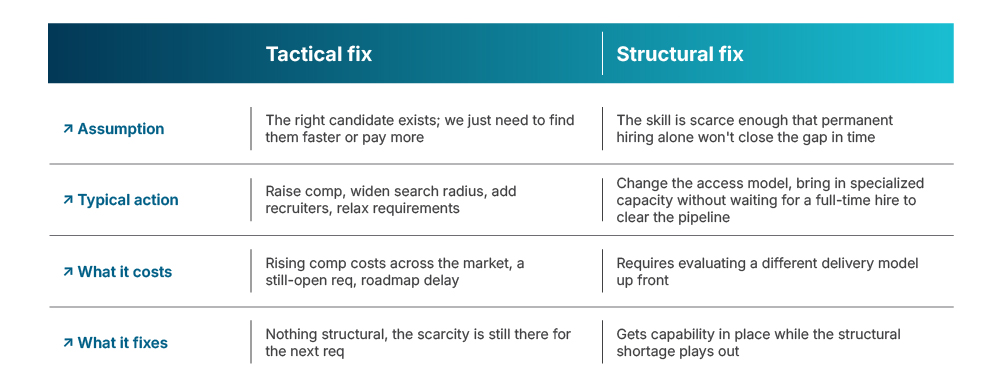
Neither column is right for every situation. But most teams stuck in a long, expensive search are running the left column on a problem that actually needs the right one.
Signals you're solving a structural problem tactically
A few patterns tend to show up together: the same role has been reopened or re-scoped more than once in the past year; comp for the role has increased faster than comparable roles elsewhere in the org without meaningfully improving the applicant pool; the skill in question is narrow enough that only a handful of candidates in your search radius plausibly have it; or the roadmap item this role supports has already slipped because the seat stayed open.
If two or more of those sound familiar, it's worth evaluating a different access model rather than running the same search again with a bigger budget. That's a different question from "which vendor", our guide to evaluating a staff augmentation vendor walks through what to ask once you've decided to look outside the traditional hiring pipeline. And if the specific gap is on the AI/ML side rather than core data engineering, AI roles carry their own version of this shortage with an even narrower qualified pool.
The Netscribes view
The data engineering talent shortage isn't going away by hiring harder. Extended Data Teams exist for exactly this gap, production-ready, domain-matched engineers you can bring in without restarting the same search that's already cost you a quarter.
See how Extended Data Teams solve this differently at Netscribes.
FAQs
1. Why is it so hard to hire data engineers?
The core issue is a structural mismatch: demand for specific, in-demand data and AI skills has grown quickly (LinkedIn data suggests roughly 1.3 million new AI-related roles emerged over about two years, even as overall hiring slowed), while the pool of people with deep, current experience in those specific skills hasn't grown at the same pace. Tactical fixes like raising pay or widening the search mostly compete for the same limited pool rather than expanding it.
2. Is there a shortage of data engineers?
There's good evidence of a shortage in specific, high-demand skill areas, particularly around production ML, LLM engineering, and modern data platform work, rather than an even shortage across all data engineering roles. Broader claims about the size of that gap vary a lot depending on the source, so it's worth treating precise ratios or timelines you see cited online with some skepticism unless they point to a named, traceable study.
3. Why are data engineering roles hard to fill?
Beyond raw scarcity, roles that require both technical depth and sector/domain context (understanding a specific industry's data environment, not just the tools) are especially hard to fill through a generic hiring pipeline, because the qualifying pool shrinks further once domain fit is added to the technical bar


