Every internal audit function believes it has already modernized. Most haven't. They moved off compliance checklists years ago, adopted risk-based planning, and called the transformation complete. That belief is the single biggest obstacle standing between today's audit function and the one the business actually needs in 2026.
There is a maturity ladder underneath every audit strategy conversation, whether or not anyone names it out loud. Four rungs. Most functions are standing on the second one, mistaking it for the top.
The Four Rungs of Internal Audit Maturity
What is an internal audit maturity model?
An internal audit maturity model is a framework that classifies an audit function's operating approach into progressive stages, from basic compliance checking through to predictive, strategic assurance. It helps CAEs benchmark where their function currently sits and identify the specific capability gaps that separate their current state from the next level of value delivery.
The ladder has four rungs.
Rung 1: Compliance-focused.
Audit exists to confirm that policies were followed and controls were documented. Coverage is narrow, cyclical, and backward-looking. The output is a checklist, not an insight.
Rung 2: Risk-based.
Audit plans are built around risk assessments. Resources go where exposure is highest. Sampling replaces exhaustive testing. This was a genuine leap forward when it became the industry standard, and for most functions, it is still where the story ends.
Rung 3: Continuous, data-driven.
Audit moves from periodic snapshots to ongoing monitoring. Transaction-level data feeds automated control checks. Exceptions surface in near real time instead of at year-end. Coverage stops being a sampling exercise and becomes a population-wide one.
Rung 4: Predictive, strategic.
Audit uses historical exception patterns and control-failure signals to anticipate where the next breakdown is likely to happen, before it happens. At this rung, audit sits at the table as a forward-looking advisor on organizational risk, not a rear-view mirror.
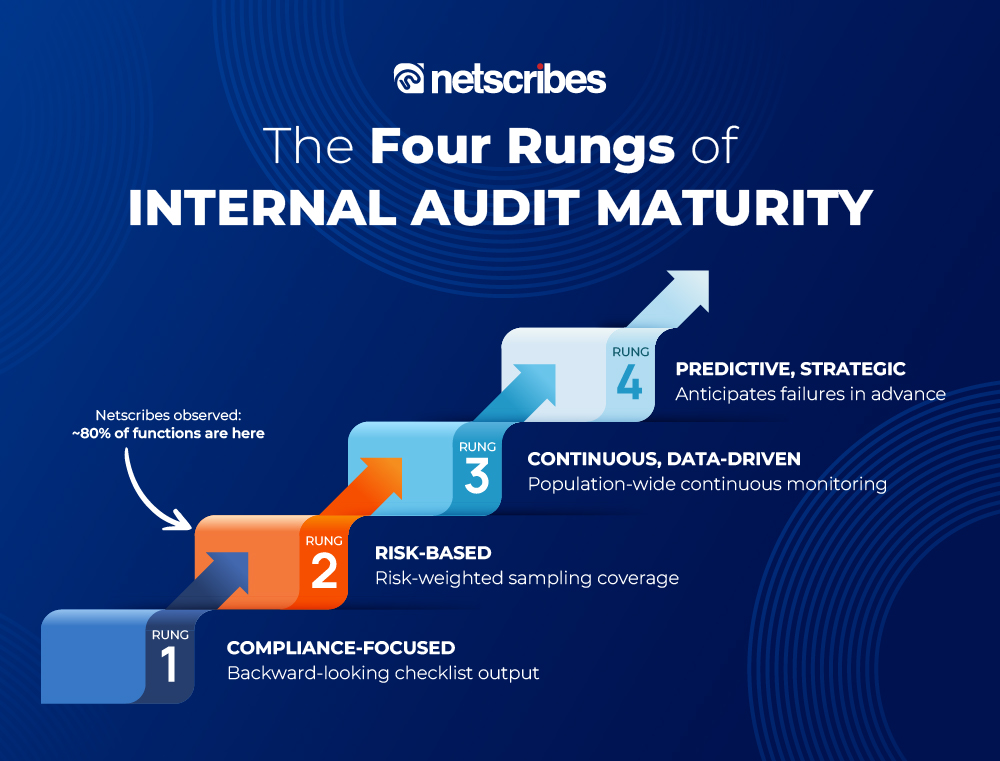
Most functions today sit on Rung 2. Based on Netscribes’ engagement experience across audit transformation projects, an Netscribes-observed pattern is that roughly four in five audit functions we assess remain anchored at the risk-based stage, having made no structural move toward continuous monitoring. That figure is directional and reflects our own client base rather than a formally published industry census, but the pattern holds consistently enough to be worth naming.
Why Rung 2 Feels Like the Finish Line (But Isn't)
Risk-based auditing earned its place. It replaced blanket compliance testing with a smarter allocation of scarce audit hours, and for the era it emerged in, that was the correct call. The problem is that risk-based planning still rests on two assumptions that no longer hold up: that audit coverage happens periodically, and that a sample can stand in for the whole population.
Sampling was a compromise built around a constraint that has since disappeared. Auditors couldn't manually review every transaction, so they tested a representative slice and extrapolated. An Netscribes-observed benchmark across client audit environments puts typical sample coverage at around five percent of the transaction population, meaning roughly ninety-five percent of transactions in a given cycle are never individually examined. Again, this figure reflects Netscribes’ own observed engagement data rather than a universal external statistic, and readers should treat it as directional rather than a fixed industry number.
That gap was tolerable when the alternative was economically impossible. It is a much harder gap to defend now that the data infrastructure to close it exists and competitors are starting to use it. A risk-based audit plan built entirely on periodic, sampled testing was the right upgrade for 2016. It is not sufficient for the volume, velocity, and regulatory scrutiny audit functions face in 2026.
What Rung 3 Actually Requires
Continuous, data-driven auditing is not a single tool purchase, and it is not primarily a technology project. It is a methodology upgrade that happens to need a data engineering backbone underneath it. Three components make it work.
Data access and pipeline infrastructure.
Audit needs a reliable, repeatable pipeline into the transaction systems it monitors, not a quarterly data extract requested from IT and delivered as a spreadsheet. This is the unglamorous foundation everything else depends on, and it is the piece most functions underestimate.
Automated control monitoring.
Once the pipeline exists, controls can be tested against the full population continuously rather than sampled periodically. A three-way match, a segregation-of-duties rule, a threshold check can all run against every transaction as it happens, rather than against a slice of transactions months later.
Exception triage workflow.
Continuous monitoring generates continuous output, and without a triage process, that output becomes noise instead of insight. Auditors need a workflow that routes flagged exceptions by severity and pattern, so human judgment gets applied where it matters most instead of being spread evenly across everything the system surfaces.
None of this replaces professional audit judgment. It changes what auditors spend their judgment on.
The Rung 2 to Rung 3 Transition: What Changes and What Doesn't
The shift from Rung 2 to Rung 3 changes the mechanics of the work. It does not change the profession underneath it.
What changes: Data preparation becomes an ongoing discipline rather than a per-engagement scramble. Audit cycle timing shifts from a fixed annual or quarterly rhythm toward rolling, continuous coverage. The exception workflow becomes the primary unit of audit activity, replacing the sample-and-report cycle.
What doesn't change: Professional standards still govern the work. Auditor judgment still decides what an exception means and how it should be escalated. The advisory relationship between audit and the business it serves is not automated away; it is freed up, because auditors spend less time gathering evidence and more time interpreting it.
Rung 3 amplifies the auditor. It does not replace the auditor. Functions that frame the transition as a headcount reduction story tend to meet internal resistance and stall before implementation finishes. Functions that frame it as a capability upgrade for existing staff tend to move faster and get more support from the audit committee.
What Rung 4 Looks Like, and Why It Starts at Rung 3
Predictive audit is the rung most CAEs are curious about and the rung almost none of them can reach directly. At Rung 4, audit uses historical exception data and control-failure patterns to flag where a breakdown is likely to occur before it does, shifting the function from detection to anticipation.
That capability has a hard prerequisite. Predictive models need a continuous, structured stream of exception and control data to learn from. A function still running periodic, sampled audits simply does not generate the data density that predictive modeling requires. There is no shortcut from Rung 2 to Rung 4. The continuous data foundation built at Rung 3 is what makes Rung 4 possible at all, which is why the Rung 2 to Rung 3 transition is the strategically decisive move on this entire ladder, not a stepping stone to skip past quickly.
Conclusion: The Window to Move Is Now
Audit committees are starting to ask sharper questions about coverage, and regulatory expectations under frameworks like the IIA's Global Internal Audit Standards and the Three Lines Model continue to push toward stronger, more demonstrable assurance over control effectiveness. A CAE who moves their function to Rung 3 in 2026 will be operating with continuous coverage, a live exception pipeline, and an early foothold on predictive capability while peers are still debating whether automation belongs in the audit plan at all.
Netscribes works with audit functions across every rung of this ladder, and our proof-of-concept model is built specifically to move a Rung 2 function into Rung 3 without a multi-year transformation program. A working pilot, scoped and running in two to four weeks, is what we use to demonstrate the shift rather than theorize about it. That two-to-four-week timeframe is an Netscribes-documented delivery benchmark rather than a universal industry figure, and results will vary by data environment and scope.
The gap most audit functions hit at this transition is not a judgment gap. It is a data engineering gap, and that is the specific piece Netscribes is built to close. Our teams pair audit domain expertise with hands-on data engineering delivery, so the work starts with how your transaction systems, ERP, and GRC tools actually store and expose data, not with a generic automation template that assumes clean, accessible pipelines already exist.
In practice, that support covers three things: building the data pipeline into your existing systems so continuous testing has something reliable to run against, configuring automated control checks against the full transaction population instead of a sample, and setting up an exception triage workflow that routes findings by severity so your auditors are reviewing what matters instead of wading through unfiltered system output. The PoC is scoped around one process or control area, so the audit team sees the mechanics working on real data before committing to a broader rollout.
None of this requires replacing your existing audit management or GRC platform. Netscribes builds the data layer and monitoring logic to work alongside what you already run, which is part of why the transition timeline stays measured in weeks rather than a multi-year re-platforming effort.
If your function is ready to find out exactly where it sits on this ladder, and what the fastest credible path to the next rung looks like, a short conversation is the place to start.
Prefer to see the methodology in action first? Read our guide on P2P audit automation for a concrete look at what Rung 3 looks like applied to a single process.