

How Netscribes drives smarter decisions and scalable innovation
A hidden roadblock to digital transformation
For many enterprises, the vision of data-driven decision-making is clouded by legacy systems, siloed data, and sluggish analytics. Each department manages its own datasets, leading to inconsistencies, inefficiencies, and costly maintenance. Without cloud data modernization, businesses risk falling behind in today’s data-driven economy. Just like running a marathon in old, heavy boots instead of lightweight running shoes would slow you down and make every step more difficult.
According to IDC, global data creation is expected to reach 175 zettabytes by 2025. Yet, a shocking amount of this data nearly 80% remains unstructured and difficult to harness for business insights.
So, what’s the way forward? How do enterprises unlock their data’s true potential? In this blog, we’ll explore why cloud data modernization is the linchpin of digital transformation, what it is, the challenges it presents, and how forward-thinking organizations can reap its benefits.
What is cloud data modernization?
At its core, cloud data modernization is the process of upgrading legacy data systems to cloud-native architectures. This involves moving from rigid, on-premise storage solutions to scalable, flexible, and high-performance cloud environments.
The challenge: Why companies struggle with data modernization
Digital transformation hinges on data-driven decision-making, but legacy systems often create roadblocks. Many enterprises face challenges such as:
- Legacy system complexity – Many organizations still rely on outdated databases and on-premise architectures that are not cloud-compatible.
- Data silos – Different departments store data in fragmented systems, making integration difficult.
- Security and compliance concerns – Industries like healthcare and finance must comply with stringent regulations like HIPAA and GDPR.
- Cost of migration – Lifting and shifting data to the cloud without a proper strategy can lead to inflated costs and inefficiencies.
- Lack of skilled personnel – Cloud modernization demands expertise in cloud architecture, data governance, and AI-driven analytics.
Without modernization, businesses risk falling behind in today’s fast-paced, data-driven economy.
The benefits: Why cloud data modernization is a game-changer
Despite these challenges, companies that successfully transition see significant cost savings, operational efficiency, and enhanced decision-making capabilities.
Migrating to a cloud-first data strategy unlocks several advantages:
- Scalability: Pay-as-you-go cloud storage grows with your business needs.
- Real-time insights: Cloud-based analytics provide immediate visibility into operations and customer behavior.
- Enhanced security & compliance: Automated controls, encryption, and role-based access protect sensitive data.
- AI & automation capabilities: Leverage machine learning, predictive analytics, and intelligent automation for better decision-making.
- Cost efficiency: Reduce IT overhead by eliminating legacy maintenance and on-premise infrastructure costs.
Read more: Accelerating digital transformation through cloud migration strategy
The future of cloud data modernization: What’s next?
Where is cloud data modernization headed? Emerging trends indicate a shift toward more advanced, automated, and intelligent cloud ecosystems:
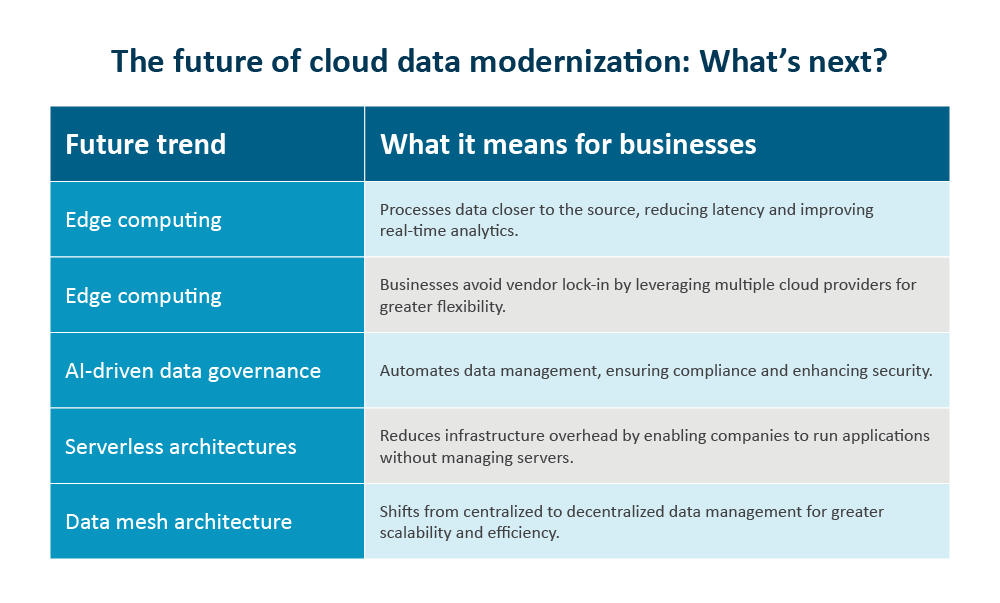
Companies that invest in these technologies will gain a competitive edge, drive innovation, and enhance business agility.
Read more: The future of master data management: Trends shaping the next generation of data engineering
Ready to modernize?
Are you ready to transform your data infrastructure for the future? At Netscribes, we specialize in data engineering solutions that help businesses migrate, optimize, and harness the power of cloud data. Discover how our data engineering services can help you transform your data infrastructure for the future.
The Netscribes cloud data modernization framework
Netscribes approaches cloud data modernization as a business program, with technology following the business priorities. The framework has five steps:
- Assess. Netscribes maps existing systems, pipelines, data silos and compliance obligations, including regulations like HIPAA and GDPR where they apply, to set a clear baseline.
- Design. Netscribes defines a cloud-native target architecture around the decisions the business needs to make faster, with security and governance built in.
- Migrate in phases. Workloads move in a planned sequence, highest-friction first, so reporting and operations keep running. This avoids the cost overruns that come with an unplanned lift-and-shift.
- Optimize. After migration, Netscribes tunes performance and cloud spend so the pay-as-you-go model actually saves money.
- Enable and run. Client teams are trained to run the new platform, or Netscribes operates it as an ongoing managed service.
FAQs
What is cloud data modernization?
Cloud data modernization means replacing rigid, on-premises data systems with cloud-native architecture that scales on demand. It covers more than moving data. Integration, security, governance and analytics are redesigned so data from every department can be combined, trusted and used for real-time insight, AI and automation.
How long does cloud data modernization take?
It depends on how many legacy systems are involved, how much data has to move, and the compliance requirements in play. An assessment and a first migrated workload can often be delivered within weeks. Moving an enterprise’s full data estate is usually a phased program that runs over several months, with value delivered along the way.
What are the stages of cloud data modernization?
Most programs follow four stages. First, assess current systems, data silos and compliance needs. Second, design a cloud-native target architecture. Third, migrate in phases, starting with high-friction workloads. Fourth, optimize and govern the new environment for cost, security and data quality. Skipping the assessment is a common reason migrations end up costing more than planned.


