

ICP research, ideal customer profile research, is the process of identifying, through primary and secondary research, which customer segments are most likely to buy, retain, and expand. It goes beyond demographic profiling to capture buying behaviour, unmet needs, decision-making structures, and how your offer is actually perceived against alternatives. Most B2B teams already have an ICP document. What they don't have, most of the time, is ICP research behind it.
That's the gap. Most ICP documents are built from CRM exports and intuition, a look at who bought, cross-referenced with a few assumptions about why. That tells you who bought. It doesn't tell you who should have bought and didn't, or who's about to become your next best customer if you position correctly. If your last three campaigns underperformed, the ICP document is one of the first places to look, and CRM data is often the reason it's wrong.
What an ICP built on CRM data gets wrong
Historical buyers are not the same population as ideal buyers. The accounts sitting in your CRM are the ones you won, through a strong relationship, good timing, or a lower price than the competition offered. They're not a representative sample of your addressable market; they're a survivorship-biased subset of it.
More importantly, the accounts you didn't win aren't in your CRM at all. The prospects who evaluated you and chose a competitor, the segment that never entered your pipeline because your messaging never reached them, the buyers who'd have converted if your positioning had addressed their actual objection, none of that shows up in a CRM query. An ICP built exclusively from internal data will always skew toward your past wins, and it will always miss the whitespace sitting just outside them.
This is usually where the "is it messaging or targeting" debate stalls out. If your campaigns are underperforming and the ICP doc hasn't changed in eighteen months, the honest answer is often both, because a targeting error upstream produces a messaging mismatch downstream. You can't fix the copy your way out of talking to the wrong segment.
What rigorous ICP research actually involves
Rigorous ICP research starts with primary fieldwork, not a data pull. That means in-depth interviews with target buyers, not just existing customers, but prospects who evaluated you and didn't buy, and buyers at companies that look like your ICP but have never heard of you. It means quantitative surveys designed to validate or reject segmentation hypotheses, not confirm them. And it means perception studies that show how your offer is actually judged against alternatives, including the ones you didn't realize you were competing with.
Layer that primary work with secondary intelligence: competitor customer bases, market segment sizing, distribution and channel analysis. This is the difference between what a go-to-market research firm does and what an internal team can pull together with a SurveyMonkey link and a Tuesday afternoon. It's also why serious GTM strategy research companies invest in structured customer segmentation research, sample design, hypothesis testing, analytical distance, rather than treating segmentation as an internal brainstorming exercise. GTM intelligence services exist precisely because this kind of fieldwork demands a level of methodological rigor that teams close to their own product, and their own assumptions, struggle to bring to their own market.
How ICP research changes what goes into a GTM strategy
When primary data replaces assumption, every part of the GTM strategy shifts. Segmentation changes because the data usually reveals that your best-fit segment isn't the one generating the most current revenue, it's one you've underserved. Messaging changes because you now know what the buyer actually cares about, rather than what your last three campaigns assumed they cared about. Pricing changes when you have real willingness-to-pay data instead of a number extrapolated from existing deals. And channel strategy changes once you understand how the buyer actually makes the decision, often a longer, more committee-driven process than your CRM's deal-stage history suggests.
The three things ICP research should tell you that your CRM can't
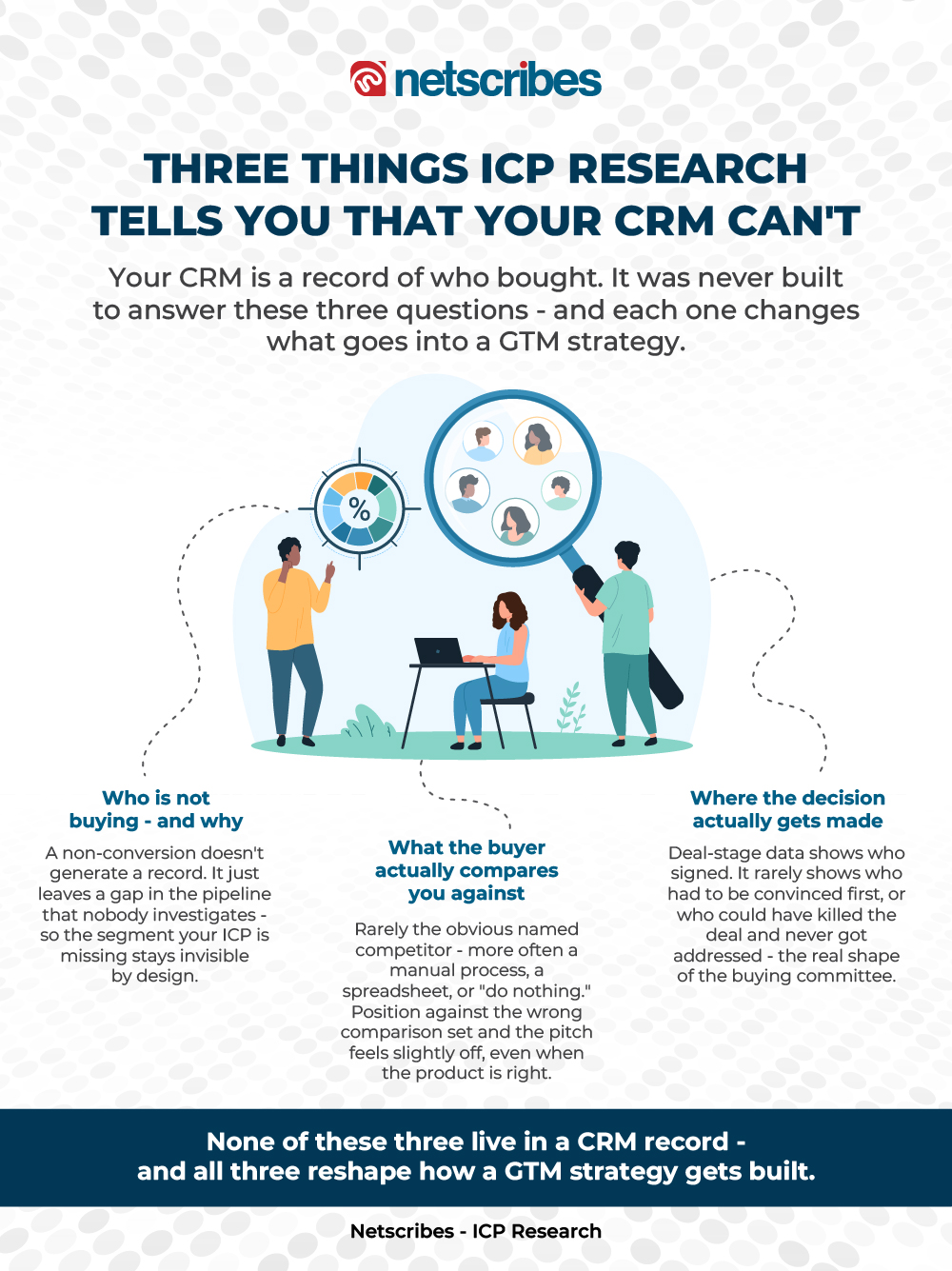
- First, who is not buying, and why. This is the segment your CRM structurally cannot show you, because a non-conversion doesn't generate a record, it just generates a gap in your pipeline that nobody investigates.
- Second, what the buyer actually compares you against, which is rarely the obvious named competitor, and more often a manual process, a spreadsheet, or a "do nothing" option your sales deck never accounts for. Positioning built against the wrong comparison set will always feel slightly off to the buyer, even when the product itself is right.
- Third, where the decision actually gets made inside the buying organisation, and who else is in the room when it happens. Deal-stage data tells you who signed; it rarely tells you who else had to be convinced first, or who could have killed the deal and didn't get addressed. None of these three live in Salesforce, and all three reshape how a GTM strategy gets built.
A real example: uncovering a new segment before launch
A PSA technology company approached us ahead of a planned market expansion with a clearly defined ICP and an established view of where demand would come from. We tested those assumptions through primary research with 800 respondents and 16 expert interviews across 8 markets.
The research revealed that the strongest opportunity was not concentrated entirely within the segment the company had originally prioritized. A previously underweighted customer segment showed stronger need for the solution and a different set of purchase drivers, creating an opportunity the existing GTM plan was not designed to capture.
That finding changed more than the target audience. It influenced how the company prioritized markets, refined its ICP, tailored its value proposition, and allocated marketing resources. Messaging could now be built around the needs of the higher-potential segment, while channel and campaign investments could be directed toward where that audience was most likely to engage.
The research also surfaced adoption barriers such as budget constraints, integration concerns, and low awareness, giving the company a clearer view of what could prevent conversion within each segment.
Instead of taking an existing ICP into a new market and increasing spend behind it, the company entered with a sharper view of who to prioritize, what would make them buy, and what could stop them from buying. That is the role of GTM intelligence: uncovering opportunity areas early enough to change where resources go before launch.
ICP research is not optional
For a B2B company preparing a launch or an expansion, ICP research isn't a nice-to-have reserved for large enterprises with research budgets to spare, it's what separates a GTM strategy built on evidence from one built on internal consensus. The cost of getting it wrong isn't a bad slide in a strategy deck; it's three underperforming campaigns and a quarter lost figuring out why.
If your ICP document hasn't been stress-tested against real buyer behaviour, that's worth fixing before the next campaign, not after. Talk to our GTM intelligence team about ICP research, or explore our consumer research capabilities to see how primary fieldwork changes what goes into a launch.
FAQs
1. What is ICP research?
ICP research is the process of defining an organization's ideal customer profile using real data and evidence, firmographics, buying behavior, win/loss patterns, rather than internal assumptions. It goes beyond listing traits a "good customer" should have; it validates those traits against actual data on who buys, renews, and churns.
2. Why isn't CRM data enough to build an accurate ideal customer profile?
CRM data only reflects who your sales team has already engaged, it's biased toward your existing outreach and targeting choices, not the full market of potential best-fit customers. It also rarely captures why a customer succeeded or churned, just that they did. Relying on CRM data alone risks reinforcing past targeting mistakes rather than correcting them.
3. What is the difference between an ideal customer profile and a buyer persona?
An ICP describes the company-level traits of a best-fit customer, industry, size, tech stack, growth stage. A buyer persona describes the individual decision-makers within that company, their role, priorities, and objections. Most B2B GTM strategies need both: the ICP defines who to target, the persona defines how to reach and message them.
4. What data sources should ICP research include beyond CRM data?
Win/loss analysis (why deals were won or lost, not just that they were), customer success and churn data (which accounts actually got value versus which quietly disengaged), external firmographic and intent data on the broader addressable market, and direct customer interviews, since CRM data can't explain motivation or context behind a decision.
5. How often should an ICP be revisited?
At minimum annually, and sooner if there's a product change, a new market entry, or a noticeable shift in win/loss patterns. An ICP built once and never revisited tends to drift out of alignment with who's actually buying and succeeding, especially as a product or market matures


