

Most companies don't struggle to find a staff augmentation vendor. They struggle to tell a good one apart from a mediocre one before signing the contract, by which point the cost of a wrong call is measured in months, not dollars.
That gap is structural, not a failure of diligence. According to Deloitte's 2024 Global Outsourcing Survey, 96% of organizations already use third-party outsourcing or augmentation in some form, but only about 17% report having a cohesive strategy for managing it across vendor types. Most companies are buying this kind of capacity constantly and evaluating it inconsistently.
The seven questions below are the ones that actually separate a partner who can deliver from one who can only staff. Ask them of any vendor you're evaluating, including Netscribes.
1. How do you evaluate domain depth, not just technical skill?
A candidate can pass a SQL and Python screen and still take three months to understand why your retail forecasting model needs to treat promotional periods differently from a BFSI risk model needs to treat regulatory reporting periods. Ask the vendor how they specifically screen for sector experience, not "have they worked in retail," but who technically vets that experience and against what standard. A vague answer here ("our engineers are versatile") is itself the answer.
2. What does a realistic ramp-up actually look like?
Every vendor will tell you their engineers ramp up fast. Few will tell you it depends heavily on your stack, your documentation, and how close their engineer's prior experience is to your specific environment. Be skeptical of any vendor that quotes a single universal number regardless of what they're stepping into, ask instead for a ramp-up plan specific to your tech stack and a description of what "productive" looks like at 30, 60, and 90 days.
3. Are engineers embedded under my direction, or delivered as a packaged team?
These are two different operating models with different accountability. In an embedded model, the vendor's engineer reports into your technical leadership and your sprint process, you direct the work day to day. In a delivered-team model, the vendor manages its own team against a scope you've defined upfront. Neither is inherently wrong, but a vendor should be able to state clearly which one you're getting, because the two create very different expectations about who owns technical decisions.
4. What's your actual depth on my specific data stack?
"We do data engineering" is not an answer. Ask which platforms, orchestration tools, and cloud data warehouses the vendor's engineers have shipped production work on recently, not just trained on. A vendor with genuine depth will ask you almost as many questions about your stack as you ask them about their experience with it.
5. How do you handle data governance and access control on client engagements?
This question matters more than most buyers initially weigh it. Ask how the vendor's engineers are provisioned access to your systems, what happens to that access when an engagement ends, and how they handle sensitive or regulated data specifically. A vendor without a clear, specific answer here is a governance risk you're inheriting, not just a staffing choice. (If AI/ML roles are part of the engagement, this question gets more complex, see our guide to AI staff augmentation for what changes when the roles involve production model risk.)
6. Can this relationship scale if my roadmap accelerates or shifts?
A vendor that's a great fit for one data engineer today may not have bench depth for three data engineers and an ML engineer in six months. Ask directly about their bench depth in your specific skill areas, and how quickly they can add capacity without a drop in the vetting bar they used for your first hire.
7. What does the exit process actually look like?
This is the question most buyers forget to ask and most vendors hope they don't. What happens to institutional knowledge, documentation, and access when the engagement ends or you want to bring the work in-house? A vendor confident in the value they deliver will have a straightforward answer. Vague or defensive answers here are a signal worth taking seriously.
Vendor evaluation scorecard
Use this to score any vendor you're evaluating, print it, fill it in during vendor calls, and compare candidates side by side.
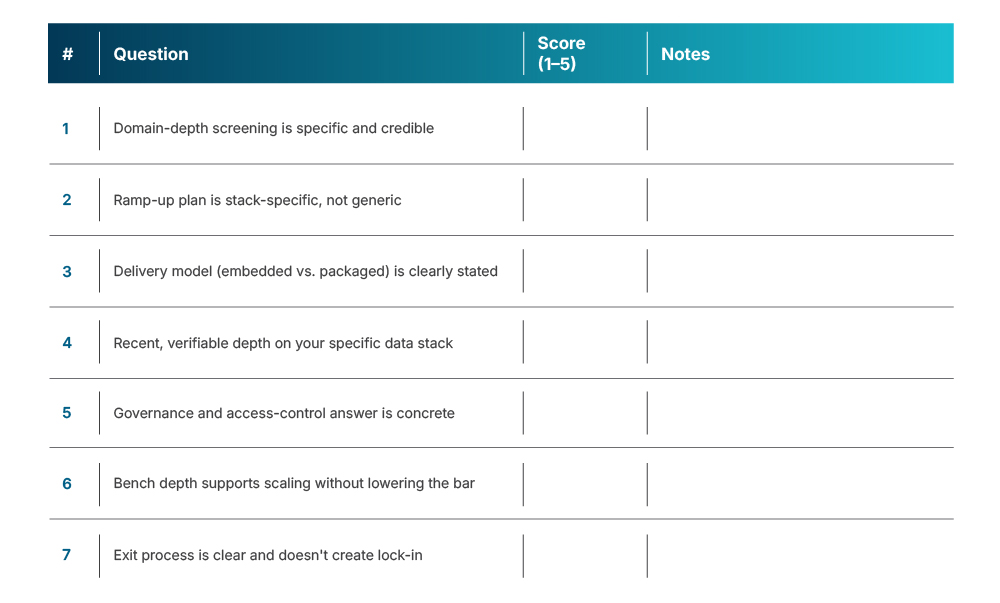
A vendor scoring low on questions 5 or 7 is worth a harder look regardless of how strong the rest of the scorecard is, those two are the ones that create risk after the contract is signed, not before.
The Netscribes view
We answer these seven questions directly for Netscribes' Extended Data Teams model, because a vendor evaluation guide that only works when you skip asking us the hard questions isn't one we'd want to publish.
See how Netscribes Extended Data Teams answer these seven questions.
FAQs
1. How do I evaluate a staff augmentation vendor?
Focus on seven areas: how they screen for domain-specific skill (not just technical skill), whether their ramp-up estimates are specific to your stack, whether engineers work embedded under your direction or as a packaged delivery team, their actual depth on your specific data platforms, how they handle data governance and access, their bench depth for scaling, and how clearly they describe the exit process at the end of an engagement.
2. What should I look for in data engineering outsourcing?
Beyond technical skill, look for sector/domain fit, a governance and access-control process you can audit, a clearly stated delivery model (embedded vs. packaged team), and a straightforward exit process. Vendors that are vague about data governance or what happens when an engagement ends are worth scrutinizing further, since those are the two areas that tend to create risk after the contract starts.
3. How do I choose a dedicated data team?
Score prospective vendors against a consistent framework rather than comparing pitches informally, the seven questions above (domain depth, ramp-up specificity, delivery model, stack depth, governance, scalability, and exit process) work as a comparable scorecard across multiple vendors, including any incumbent you're already using.


