

Most audit teams think of duplicate payments as an edge case, something a reconciliation clerk catches once in a while, or a vendor calls in about. In practice, duplicates are a structural byproduct of how accounts payable actually runs: multiple ERP instances, decentralized approval chains, and manual invoice entry all create the same failure mode over and over. The teams that only look for duplicates during quarterly reconciliation are missing most of them.
What is duplicate payment detection?
Duplicate payment detection is the process of identifying instances where an organization has paid the same invoice, or functionally the same invoice, more than once. It covers exact repeats (same vendor, amount, and date), near-duplicates (same vendor and amount but a different date or invoice number), cross-entity duplicates (two subsidiaries paying the same invoice independently), and vendor-initiated duplicates (a vendor resubmitting the same invoice under a slightly altered reference number). Detection can happen reactively, after the payment has cleared, or proactively, using data analytics to flag likely duplicates before a payment goes out.
Duplicates Are a Pattern, Not an Accident
Root causes tend to repeat across organizations. AP processing spread across multiple business units or regions, each with its own approval workflow. ERP migrations that leave historical and current-system records overlapping. Manual invoice entry, where the same paper or PDF invoice gets keyed in twice by two different people, sometimes weeks apart. None of these are unusual. They're just the normal cost of running AP at scale, which is exactly why a spot-check approach struggles to keep up.
The Four Types of Duplicates to Test For
Not every duplicate looks the same, and each type needs its own detection logic.
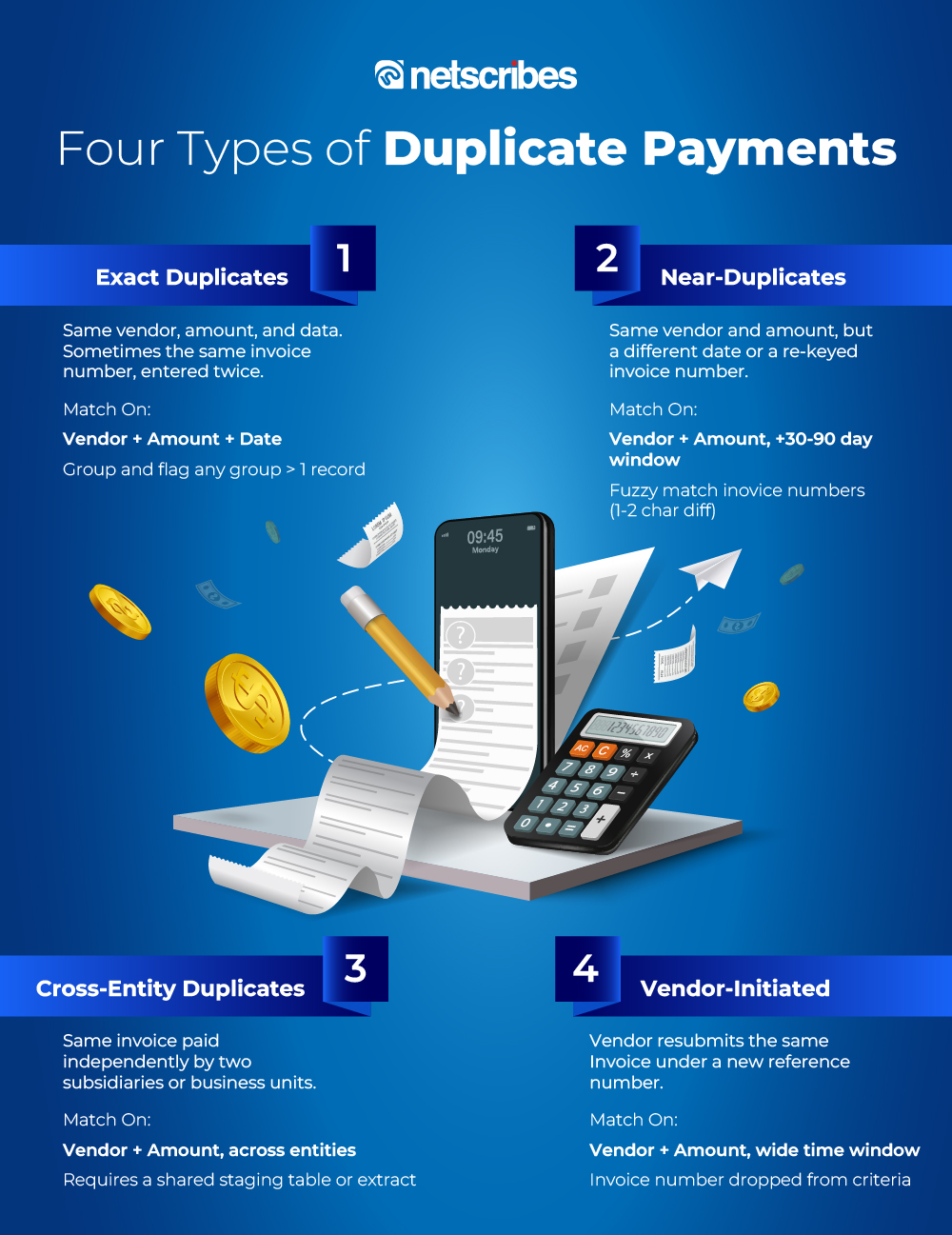
- Exact duplicates are the easiest to catch: same vendor ID, same amount, same invoice date, sometimes even the same invoice number entered twice. A straightforward match on those fields will surface most of them.
- Near-duplicates are trickier. Same vendor, same amount, but the date or invoice number is slightly different, often because the invoice was re-keyed by someone who didn't recognize it as a repeat. Catching these means loosening the match criteria: same vendor and amount, but allow the date to fall within a window, and check invoice numbers for small character-level differences rather than requiring an exact match.
- Cross-entity duplicates happen when two subsidiaries or business units process the same invoice independently, often because the vendor billed both entities or because a shared-services team split the workload without a shared payment ledger. These require pulling data across entities rather than looking at one AP ledger in isolation.
- Vendor-initiated duplicates are the hardest to catch and, from a fraud and control standpoint, often the most important. A vendor submits the same invoice under a new reference number, sometimes deliberately, sometimes because their own systems generated a new number automatically. Catching these means matching on vendor, amount, and rough timing while ignoring the invoice number altogether.
The Data You Need and Where to Get It
Detection logic is only as good as the underlying data. At minimum, you need vendor ID, invoice number, invoice date, payment date, payment amount, cost center, and approver. Most of this lives in the AP module of whatever ERP the organization runs. SAP teams will pull it from the relevant AP tables and transaction codes; Oracle and Workday environments have their own standard AP reporting objects that hold the same fields.
Before any matching logic runs, expect to spend time on data quality. Vendor IDs are often duplicated across systems for the same actual vendor. Dates get entered in inconsistent formats across regions. Amounts sometimes carry currency conversion noise if multiple entities pay in different currencies for what's really the same vendor relationship. Cleaning this up first is not optional. Skipping it just means the detection logic inherits the mess.
Writing the Detection Logic
You don't need a production analytics platform to start. The logic itself is straightforward enough to prototype in a spreadsheet or a basic SQL query before it ever gets automated.
For exact duplicates, the logic is a simple group-and-match: group payments by vendor, amount, and date, and flag any group with more than one record.
For near-duplicates, loosen the date requirement to a window, commonly 30, 60, or 90 days depending on how quickly your vendors typically resubmit, and match on vendor and amount within that window. Layer in a fuzzy comparison on invoice number, looking for numbers that differ by one or two characters, since that's a common signature of a re-keyed duplicate.
For cross-entity duplicates, the same vendor-and-amount matching logic applies, but the data has to be pulled across entities first, which usually means a shared staging table or a consolidated extract rather than querying each subsidiary's AP system separately.
For vendor-initiated duplicates, drop the invoice number from the match criteria entirely and rely on vendor, amount, and a wider time window, since these are designed to look different on the surface.
None of this needs to be production-grade code to be useful. Even a rough first pass, run manually against a quarter of AP data, will usually surface enough true positives to make the case for building it properly.
Handling False Positives, and Why They Matter
Every one of these rules will also catch payments that aren't actually duplicates. Installment payments on the same invoice, recurring vendor charges that legitimately repeat monthly, and multi-site organizations paying the same vendor for genuinely separate services at different locations will all trip a naive matching rule.
Building exclusion logic for these cases matters as much as the detection logic itself. A rule that generates a high false-positive rate gets ignored by the audit team within a few review cycles, no matter how many true duplicates it also catches. Recurring vendor relationships should be flagged and excluded from ongoing checks unless the amount or timing changes unexpectedly. Installment structures should be identified upfront, ideally from the contract or PO data, rather than re-derived every time the detection logic runs.
What Continuous Automation Adds
Run manually, this kind of analysis tends to happen quarterly, if that. It covers whatever sample the team has time to pull, and by the time it runs, the payments have already cleared. Automating the same logic against every transaction, every cycle, changes what the exercise is actually for. Instead of finding duplicates after the fact, the goal shifts to catching them before payment goes out, which is a different and more useful thing to build toward.
That shift, from periodic detection to continuous prevention, is the practical difference between a spot-check control and a system that actually closes the gap.
Where to Start
If duplicate payment detection is currently a manual, quarterly exercise built on whatever sample your team can pull together, that's the gap worth closing first. A focused proof of concept, run against two to four weeks of your own AP data, is usually enough to show whether the exclusion logic holds up and what the real detection rate looks like for your environment.
This is the exact problem Netscribes' P2P automation practice is built around. Rather than starting with a platform pitch, the team starts with your data: pulling two to four weeks of AP records, running the four detection types against them, and tuning the exclusion logic against your actual vendor base before anything gets automated. That PoC typically runs two to four weeks and gives your team a real detection rate and false-positive rate for your own environment, not a vendor benchmark. From there, the same logic can be moved into a continuous control that flags likely duplicates before payment clears, instead of surfacing them in the next reconciliation cycle. If your team wants to see what that looks like against your own AP data, that's the PoC worth running first.
FAQs
1. How do duplicate payments happen in accounts payable?
Duplicate payments most commonly occur due to invoice processing errors (the same invoice entered twice under slightly different invoice numbers), vendor resubmissions of unpaid invoices that were already processed, manual data entry across disconnected systems where the same invoice lands in two queues, and, less commonly, deliberate fraud where a vendor or internal employee intentionally submits multiple invoices for the same service.
2. What are the most common signs of a duplicate payment?
The clearest indicators are: two payments to the same vendor for the same amount within a short time window, invoices with the same or near-identical descriptions but different invoice numbers, payments just below approval thresholds that repeat regularly (a fraud indicator), and vendor bank account changes followed immediately by a new payment. Near-duplicate detection, where amounts are slightly varied or invoice numbers differ by one digit, requires automated fuzzy matching rather than manual review.
3. How do you perform a duplicate payment audit?
Export all AP transactions for the audit period with invoice number, vendor ID, amount, payment date, and PO reference. Sort and group by vendor ID and amount, then flag records where two or more fields match. Use dedicated audit software or data analytics tools (ACL, IDEA, or SQL queries) to apply fuzzy matching on invoice numbers. Manually review flagged items against supporting documentation, POs, delivery records, vendor communications, to confirm whether the match is a legitimate separate charge or an actual duplicate.
4. Can AI detect duplicate payments automatically?
Yes. Machine learning models trained on AP transaction history can identify near-duplicate patterns that rule-based systems miss, including invoices where amounts are varied slightly, vendor names are entered inconsistently, or invoice numbers follow a predictable manipulation pattern. Most enterprise AP automation platforms now include AI-based duplicate detection as a standard feature. The audit function's role shifts from running the detection to reviewing the exceptions the system flags and determining disposition.
5. How much money do organizations recover from duplicate payment audits?
Recovery rates vary significantly by organization size and AP control maturity. Third-party audit firms specializing in AP recovery typically quote $1 million recovered per $1 billion in supplier spend as a benchmark. For organizations with high transaction volumes, complex multi-vendor environments, and manual AP processes, recovery rates can be substantially higher, particularly in the first audit cycle before controls are tightened.


