

The best GTM strategy research companies combine primary and secondary research, operate across geographies and industries, and deliver a recommendation, not just a report. The difference between a research firm that generates insight and one that generates slides is whether they understand the business decision the research is supposed to inform.
That distinction matters more than most buyers realize until they're holding a deck that answers questions nobody asked. If you're evaluating GTM strategy research companies for an upcoming market entry or product launch, here are the criteria that actually separate the strong firms from the ones that will leave you re-doing the work six months in.
What a go-to-market research firm actually does (vs. what most people think)
Most buyers approach this category assuming GTM research means a market sizing study, a TAM/SAM/SOM slide, a few competitor logos, done. That's a fraction of the job and treating it as the whole job is how market entries go wrong.
A real go-to-market research firm operates across market intelligence, competitive analysis, pricing strategy, communication strategy, roll-out schedule, geographic feasibility, channel mapping, and product-market fit testing, and does all of it in combination, not as separate line items you have to stitch together yourself. A firm that only does desk research isn't a research partner; it's a starting point. It can tell you what's publicly known. It can't tell you what's true on the ground, and for a market entry, that gap is where the risk lives.
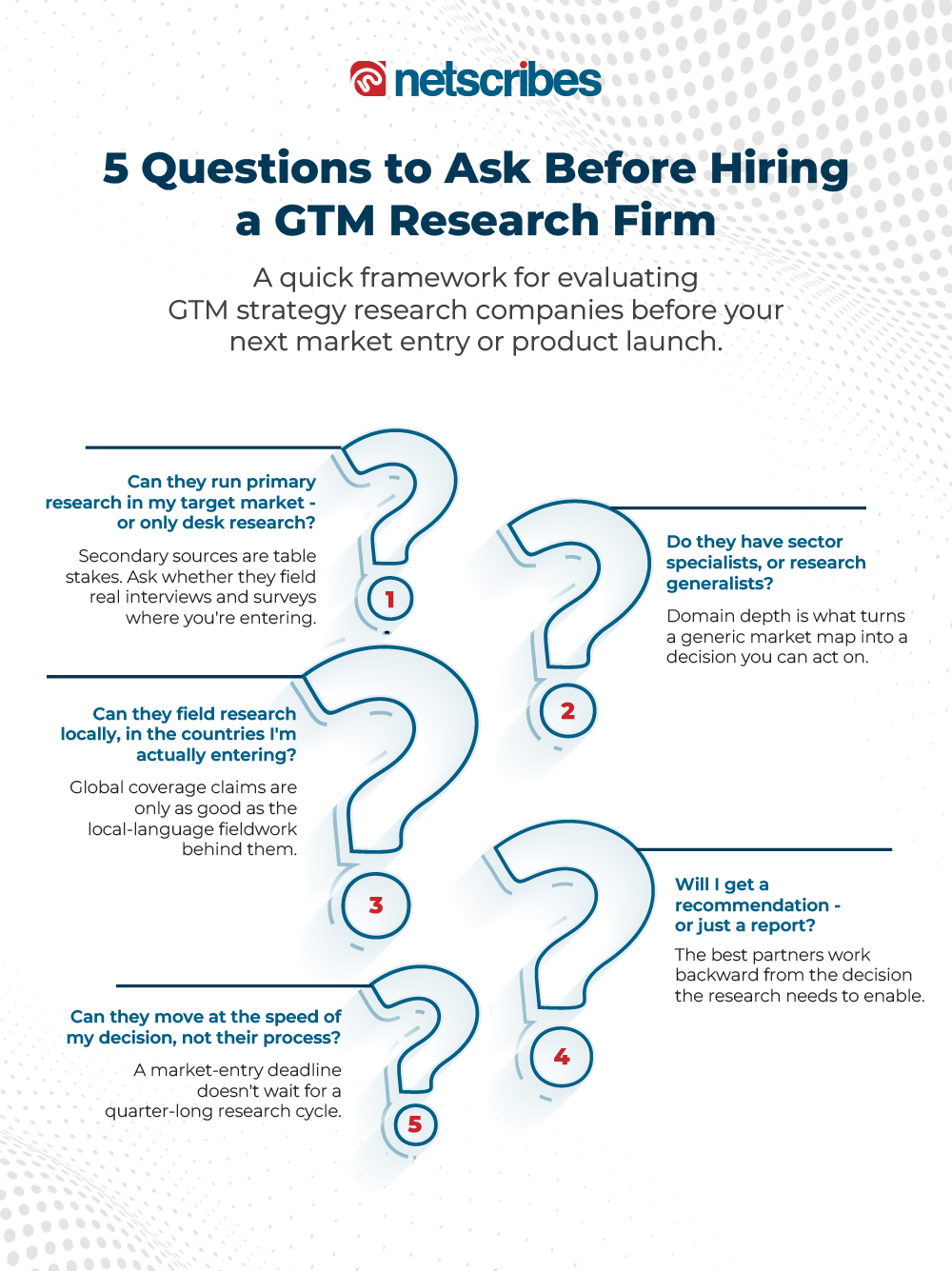
Criterion 1 - Primary research capability
Secondary research, industry reports, competitor filings, is table stakes. Every firm in this category can pull that together. The differentiating question is whether they can run primary fieldwork in your target market: expert interviews, consumer surveys, distributor conversations, KOL panels, conducted in the geography you're entering with the respondents who actually matter to your decision.
This is where a lot of GTM strategy research companies quietly fall short, they have the analytical framework but not the on-the-ground fieldwork infrastructure to fill it with real data. As reference points, Netscribes' primary research work has included fielding roughly 6,000 surveys across multiple markets, engaging around 900 healthcare stakeholders across multiple countries, and running approximately 1,600 consumer surveys across metros, non-metros, Tier-1,2, 3 cities for clients making market-entry decisions. (These figures come from past engagement scopes; if you're citing them externally, it's worth confirming current figures with the Netscribes team directly.) These aren't desk research outputs, they're the kind of data that only exists if a firm has the capacity to go out and collect it.
Criterion 2 - Industry depth
A generalist research firm will hand you a generic market map, the kind you could largely reconstruct yourself from public sources. A firm with real domain expertise will tell you which segment the category leaders are underserving, why the distribution model in that geography doesn't map to what you're used to at home, and what the regulatory environment actually means for your entry timeline, not just that a regulation exists.
That depth doesn't come from a research methodology. It comes from having sector specialists on the team who've worked the category before, in technology, healthcare, FMCG, retail, or wherever your entry is happening. GTM strategy research companies worth working with staff for domain expertise, not just research generalists who can be pointed at any brief.
Criterion 3 - Geographic reach and local intelligence
Global market entry research is only as good as the local data underneath it. It's one thing to claim "global coverage" in a pitch deck; it's another to actually run comparable-quality primary research in multiple countriesin the same engagement. Ask directly: does the firm have partner networks for local-language fieldwork, or are they subcontracting blind and hoping the quality holds?
This is a fair question to press on, because the answer varies enormously across the category. Netscribes operates across 90+ countries with a local-language partner network spanning roughly 140 languages, infrastructure that exists specifically because local nuance (language, cultural context, on-the-ground relationships) is what makes primary research in an unfamiliar market usable rather than approximate.
Criterion 4 - Recommendation, not just research
This is the single most important question to ask before signing a contract with any go-to-market intelligence services provider: what decision will this research enable, and how will the output be structured to make that decision?
Some research firms will hand you a 200-slide deck of findings and consider the engagement complete. The best GTM strategy research companies work backward from the decision, a ranked list of markets to prioritize, a defined entry sequence, a positioning call grounded in evidence rather than internal consensus. If a potential partner can't answer clearly, upfront, what decision their output is built to support, assume the output will be a report you file away rather than a recommendation you act on.
Criterion 5 - Speed to insight
GTM decisions rarely come with unlimited runway. There's usually a board presentation, a launch date, or a competitor move forcing the timeline. A GTM data research firm that needs a full quarter to scope and deliver primary research is optimizing for its own process, not your deadline.
The right partner can scope and execute a proof-of-concept study, market sizing, a first round of primary interviews, a competitive intelligence baseline, in weeks, fast enough that the findings actually reach the decision while it's still being made, not after.
How Netscribes approaches GTM research
Netscribes builds go-to-market research around the combination that actually holds up under real decisions: market intelligence, competitive intelligence, and consumer research run together, using both primary and secondary methods, across 90+ countries, with domain depth in technology, FMCG, healthcare, and retail. The output is built around the decision you're trying to make, not a deck that summarizes what was found.
If you're weighing GTM strategy research companies for an upcoming market entry, talk to our team before the brief is written, it's the point where the scope of the research still has a chance to be shaped around the actual decision ahead of you.
FAQs:
1. What does a GTM strategy research company actually do?
It combines market sizing, competitive landscape analysis, and buyer research to inform a market entry or launch decision, distinct from execution-focused GTM consulting, which helps build and run the plan. Some firms do both; it's worth clarifying which one you're actually hiring for before signing.
2. How do you choose the right GTM research partner for a market entry?
Prioritize firms with primary research capability (not just secondary desk research) and genuine experience in your target market, GTM dynamics vary significantly by industry and geography. Ask for a specific past engagement: what data informed the recommendation, and how the client actually used it. Vague answers here are a bigger red flag than an unfamiliar firm name.
3. What's the difference between GTM strategy consulting and market entry research?
Market entry research answers a specific question, is this market viable, and for whom, through primary and secondary research. GTM strategy consulting typically goes further, turning that research into a full execution plan: channel strategy, positioning, and launch sequencing. Some engagements bundle both; others sell them separately, so it's worth confirming scope upfront.
4. What questions should you ask before hiring a GTM research firm?
Ask what percentage of their past work was in your specific industry and geography, not just general market research. Ask how they'd validate findings, primary research with real buyers, or projections from secondary data alone. And ask what the actual deliverable looks like: a static report, or an ongoing view you can act on as the market entry unfolds.
5. How long should GTM research take before a market entry decision?
It depends on scope, but a focused market entry study, sizing, competitive landscape, and buyer validation, typically takes several weeks rather than several days. Rushed timelines are a warning sign: reliable primary research, especially reaching real buyers in an unfamiliar market, takes time to execute properly


