

When a CFO asks "what will it cost to build out our data engineering team," most CTOs answer with a salary number. That's the visible cost and it's usually the smallest piece of the real picture. Between recruiting time, benefits overhead, and the months it takes a new hire to become fully productive, the true cost of an in-house data engineering team typically runs well above the number on the offer letter.
Here's a grounded breakdown of what building a data engineering team actually costs under three models, fully in-house, generic staff augmentation, and a domain-matched model like Netscribes' Extended Data Teams, so you can budget with real numbers instead of guesses.
What a data engineer actually costs, in-house
Current market data puts average base salary for a data engineer in the US at roughly 123,000–137,000 a year, with a 10th–90th percentile spread of about 105,000–163,000, and senior engineers (8+ years' experience) reaching around $164,000 in base pay, according to Salary.com, ZipRecruiter, and Indeed data pulled in August 2026. These numbers vary by city, seniority, and specialization (a platform-focused data engineer and an ML-pipeline specialist won't command the same rate), so treat them as a directional range rather than a fixed number for any one hire.
Base salary is only part of the bill. The U.S. Bureau of Labor Statistics' Employer Costs for Employee Compensation report (March 2026) found that benefits account for roughly 31.6% of total civilian worker compensation, with wages making up the remaining 68.4%. In practical terms, that means total loaded cost, salary plus benefits, payroll taxes, and standard overhead, typically runs about 1.3–1.5x the base salary figure once you include health insurance, retirement contributions, payroll taxes, and other standard benefits.
Then there's the hiring process itself. One widely cited estimate from Jörgen Sundberg, CEO of Link Humans (referenced by SHRM and multiple industry sources), puts the full cost of recruiting, hiring, and onboarding a new employee at up to $240,000, a figure that reflects recruiter time, interview hours, onboarding, and lost productivity during ramp-up, not just agency or job-board fees. It's an estimate rather than a government statistic, so treat it as an order-of-magnitude signal, not a precise line item for your budget.
Timing compounds the cost. SHRM's 2025 Recruiting Benchmarking Report puts the average time-to-fill across all U.S. positions at 44 days, but specialized tech roles, including data engineering, commonly run 48 to 89 days depending on seniority and how niche the skill set is. Every week a seat sits open is a week of roadmap work that doesn't happen.
The staff augmentation alternative
Generic staff augmentation removes two of those three cost layers almost entirely. There's no benefits overhead, the augmentation vendor employs the engineer and handles that cost as part of the engagement fee. There's no 48–89 day search, a vendor with bench capacity can typically start someone in days to a few weeks rather than months.
What generic augmentation doesn't remove is ramp time. An engineer with strong general data engineering skills but no exposure to your specific domain, your data models, your compliance requirements, your industry's typical pipeline architecture, still needs real time to become fully productive, even though they were fast to start. That's the gap that shows up later in the budget, as slower initial delivery, even after the headline hiring costs disappear.
Where domain-matched augmentation changes the math
This is the piece most cost comparisons skip. An engineer who has already worked inside BFSI transaction systems, retail POS and inventory data, or manufacturing IoT streams starts productive work on your problem sooner, because the domain-specific learning curve, not just the technical one, is already behind them. That's the premise behind Netscribes' Extended Data Teams model: engineers who are pre-vetted for both technical depth and sector experience relevant to CPG, BFSI, retail, and manufacturing data environments.
We're not going to attach a specific "X% faster" number to that advantage here, because it depends on the complexity of the environment and the specific hire, but directionally, matching domain experience to the problem removes a real cost that a generic augmentation search doesn't address.
Cost comparison at a glance
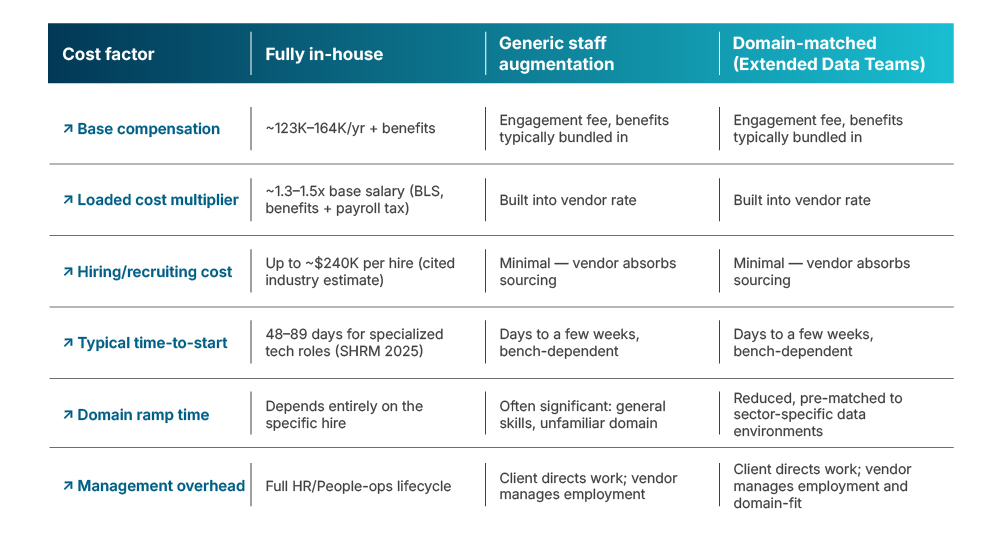
Building the right comparison for your budget
The honest version of this comparison isn't "in-house is expensive, augmentation is cheap", it's that each model shifts different costs around. In-house hiring carries the highest fixed cost and the longest lead time but gives you full ownership and control. Generic augmentation solves the speed and overhead problem but can leave a domain-knowledge gap that shows up later as slower delivery. Domain-matched augmentation is built specifically to close that gap, the model behind Extended Data Teams.
If you're building a real budget, the numbers to plug in are your target role's local salary range, a loaded-cost multiplier of roughly 1.3–1.5x that base, and a realistic estimate of how long a genuinely qualified hire takes to find in your market, then weigh that against what a domain-matched vendor engagement would cost for the same seat.
Get a cost estimate for your data team. Contact us.
FAQs
1. What does it cost to build a data team?
For a fully in-house hire, budget roughly 1.3–1.5x the base salary once benefits and payroll taxes are included (a data engineer's base typically runs 123K–164K depending on seniority), plus recruiting and onboarding costs that industry estimates put as high as $240,000 per hire, plus 48–89 days of search time for specialized roles. Staff augmentation and domain-matched models remove most of the recruiting and ramp-time costs but shift the cost structure to an ongoing engagement fee.
2. How much does a data engineer cost per month?
Loaded monthly cost for an in-house US data engineer, salary plus benefits and overhead, typically works out to roughly 10,500–18,500/month depending on seniority and location, based on current base-salary data plus the ~1.3–1.5x loading factor from BLS compensation data. Augmentation and dedicated-team engagement fees vary by vendor, region, and seniority, so ask any vendor for a role-specific quote rather than relying on a general benchmark.
3. What is the cost of outsourcing data engineering?
It depends heavily on the vendor, region, and engagement model, so there isn't a single reliable industry-wide figure. What's consistent across sourced industry reports is that outsourcing and augmentation models remove most of the recruiting cost and search-time cost associated with in-house hiring; the tradeoff to evaluate is whether the vendor's engineers already understand your specific data domain, since that affects how quickly the engagement pays off


