

Walk onto any modern factory floor and you'll find sensors tracking vibration, temperature, throughput, and defect rates every few seconds. Walk into the boardroom of that same company and you'll often find executives still waiting on last month's numbers. Manufacturing generates more raw data than almost any other industry, yet it consistently trails other sectors in turning that data into decisions. The data was never the problem. Getting it into one place was.
Data engineering for manufacturing is the work of connecting shop-floor systems (the sensors, machines, and production software that run the plant) with business systems (the software that runs the company) so that both sets of data can be analyzed together. In practice, this means building the pipelines, storage, and governance that let a plant manager, a supply chain lead, and a CFO all work from the same trustworthy numbers, whether that number is a machine's vibration reading or a quarterly cost report.
The Data Paradox in Manufacturing
A single production line can throw off more readings in an hour than a typical back-office team processes in a week. Sensors on machines, quality-control systems, energy meters, and logistics trackers are all constantly generating information. And yet, when manufacturing leaders are asked to rate how mature their analytics capabilities are, they routinely rank below leaders in financial services, technology, and even healthcare. One recent industry analysis of cross-sector analytics maturity put manufacturing at the bottom of the pack it studied, well behind financial services and technology firms on the same scale.
The reason isn't a shortage of data. It's that the data that runs the plant and the data that runs the business have never lived in the same place, or spoken the same language.
The Operational Technology (OT) / Information Technology (IT) Divide: Why Factory Data Doesn't Reach the Dashboard
Most manufacturers already know this problem by name, even if they don't call it "OT/IT integration." On one side sit the systems that run the physical plant: the machine controllers, the sensor networks, the production-line software that keeps equipment running safely and on schedule. On the other side sit the systems that run the business: the ERP, the supply chain planning tools, the CRM, the finance software.
These two worlds were built for different purposes by different teams, often years or even decades apart, and they were never designed to talk to each other. Shop-floor systems speak in machine signals and production events, refreshed by the second. Business systems speak in transactions, forecasts, and monthly closes. One team reports to a plant manager and cares about uptime. The other reports to a CFO and cares about margin. Neither was ever asked to hand its data to the other, so neither one did.
The result is a factory that is drowning in operational detail and a business that has almost none of it. A machine can be signaling early wear on a bearing for weeks before that information ever reaches the person who decides whether to schedule maintenance or approve next quarter's capital plan.
What Changes When Factory and Business Data Are Unified
The value of closing this gap isn't abstract. It shows up in specific, everyday decisions:
- Predictive maintenance. Instead of servicing equipment on a fixed calendar, a maintenance signal from the machine itself, cross-referenced with production schedules and parts inventory, tells the team exactly when a specific part is likely to fail and whether there's a maintenance window that won't disrupt output.
- Yield and quality optimization. Production data and quality-inspection data, viewed together in real time rather than reconciled after the fact, make it possible to catch a drifting process before it turns into a batch of defective product.
- Supply chain disruption detection. A shipping delay or a supplier's capacity signal, combined with what's actually sitting in the ERP, gives a team enough lead time to reroute or re-source before a line runs out of a critical input.
- Energy efficiency. Machine-level energy readings, paired with what that energy actually costs the business, turn "the plant used more power this month" into "this specific line, at this specific shift, is costing us more than it should."
None of these are new ideas in manufacturing. What's new is having the infrastructure to see them together, instead of after the fact, in separate reports that nobody has time to reconcile.
How to Build the Manufacturing Data Platform
The technical shape of this is more straightforward than it sounds, even if the engineering work behind it is substantial.
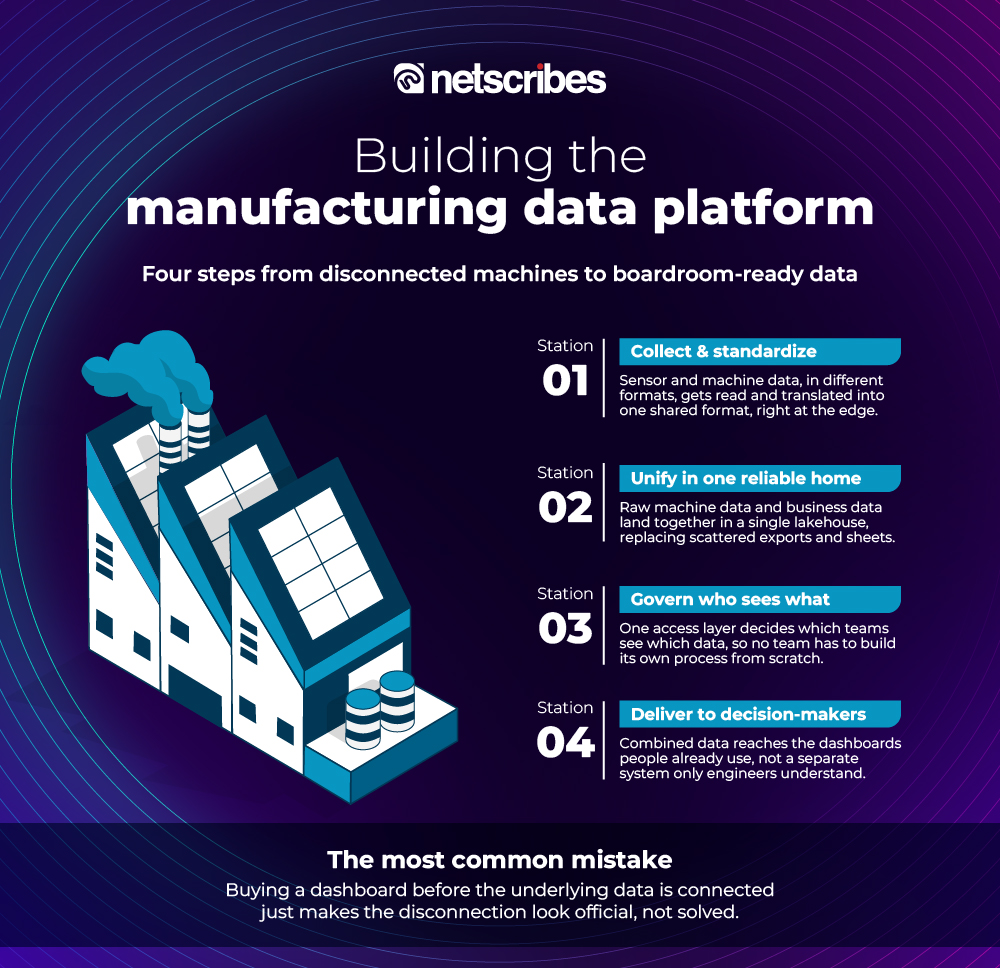
- First, factory-floor data has to be collected and standardized. Sensor readings, machine logs, and production events come from equipment that speaks different protocols and formats, so they need a collection layer that reads them all and translates them into a shared format, often processed right at the edge, close to the machines, so that only clean, useful data has to travel further.
- Second, that data needs a single, reliable home instead of dozens of disconnected exports and spreadsheets. This is the "lakehouse" layer that platforms like Databricks are built around: one place where both raw machine data and business data land, get cleaned up, and stay available for anyone who needs them, rather than three different versions of the truth sitting in three different systems.
- Third, that shared data needs one set of rules about who can see what and how it can be used. A plant engineer, a supply chain analyst, and a finance team all need access to overlapping data, but not necessarily the same view of it, and a single governance layer (Databricks' Unity Catalog serves this role) makes sure the right people see the right data without every team building its own access process from scratch.
- Finally, the combined data needs to actually reach the people making decisions, through the dashboards and analytics tools they already use, not through a separate system only engineers understand.
The most common mistake is starting with the wrong end of this chain: buying a dashboard tool before the underlying data is actually connected. A polished dashboard sitting on top of disconnected data just makes the disconnection look more official.
The Implementation Path: From Siloed to Unified
The manufacturers who get this right don't try to connect every machine and every system at once. They start narrow: one production line, one type of sensor data, one business system it needs to talk to. They build that single connection, prove it produces something a plant manager or a finance lead actually uses, and only then expand to the next line or the next data source.
A realistic path looks something like this: in the first month, pick one high-value use case (often predictive maintenance on a bottleneck piece of equipment) and connect that one data source to the systems that need it. In the second month, get that data flowing reliably and put it in front of the people who'll act on it. By the third month, use what that first connection proved to justify expanding to the next line or the next use case.
Trying to unify everything at once is how these projects stall. Proving value on one line is how they get funded to keep going.
Where This Leaves Manufacturing Leaders in 2026
The manufacturers that connect their factory-floor data with their business data this year won't just have better dashboards. Within a year and a half, they'll be making maintenance, quality, and supply chain decisions with information their competitors are still waiting weeks to see. That gap compounds. It's a structural advantage, not a one-time upgrade.
If you're trying to figure out where to start, that's exactly the conversation worth having before committing to a platform or a vendor.
Ready to see what this looks like for your plant? [Schedule a 30-minute manufacturing data engineering scoping call] to map out where your OT and IT data actually stand today, and what the fastest path to unifying them would look like.
Want to see how we approach the OT/IT integration challenge more broadly? [See our approach to manufacturing data infrastructure].
FAQs
1. What is OT/IT integration in manufacturing data engineering?
OT (Operational Technology) refers to the systems that run the physical factory floor, SCADA systems, PLCs, DCS, and MES platforms generating sensor and machine data. IT (Information Technology) refers to the business systems, ERP, supply chain, CRM, and financial platforms. In most manufacturing organizations, these two ecosystems were built by different teams, on different protocols, with no expectation that they'd ever need to share data. OT/IT integration is the data engineering work of connecting these two worlds into a single governed platform so that operational signals (like machine sensor data) and business context (like ERP and supply chain records) can be analyzed together rather than in separate silos.
2. Why do manufacturing companies generate so much data but get comparatively little analytical value from it?
The gap isn't data volume, a modern factory floor generates far more sensor data per hour than most organizations analyze in a week. The gap is infrastructure: that operational data typically lives entirely within OT systems and never reaches the business intelligence and analytics layer where strategic decisions get made. Without a data engineering layer that connects OT and IT data, predictive maintenance runs on gut feel rather than sensor signal, supply chain disruptions are detected late, and quality issues surface with the customer rather than on the line.
3. What does a manufacturing data lakehouse architecture typically look like?
A manufacturing-specific lakehouse architecture generally includes an OT data ingestion layer (IoT connectors and, where needed, edge computing to handle sensor data volume and latency), normalization of that data into a common storage format like Delta Lake alongside business data from ERP and supply chain systems, unified governance through a catalog like Unity Catalog so lineage and access control apply consistently across both operational and business data, and a consumption layer (such as Databricks SQL) where both operations and business teams can query a shared, governed dataset rather than working from separate silos.
4. Should manufacturers integrate OT and IT data all at once, or in phases?
A phased approach is generally more reliable than attempting a full integration in one project. The practical starting point is to connect one OT data source (a specific production line's sensor data, for example) with one IT system (such as the relevant ERP module), build and validate that integration, and demonstrate value on a single concrete use case, predictive maintenance or yield variance detection are common starting points, before expanding to additional data sources and systems. Attempting to integrate every OT and IT system simultaneously significantly increases both technical risk and time-to-value


