Data integration is a cornerstone of modern business intelligence. Imagine your business is experiencing rapid growth, and data is pouring in from multiple sources customer feedback, sales reports, website analytics, and even IoT devices. You’re tasked with integrating all this data into a single system to drive actionable insights. But here’s the catch: ETL vs ELT which approach is the right one for your business?
These two methods of managing and processing data may sound similar, but they differ significantly in functionality and best use cases. In this blog, we’ll break down ETL vs ELT, explore their key differences, and help you determine the ideal choice for your business.
Why data integration matters more than ever
Today’s businesses are generating massive amounts of data. But raw data is only useful when it’s accessible, organized, and ready for analysis. This is where data integration comes in, bridging the gap between data sources and actionable insights.
However, not all integration methods are created equal. ETL (Extract, Transform, Load) vs ELT (Extract, Load, Transform) represent two distinct strategies for data processing, each designed for specific infrastructure and goals. Selecting the right one could be the difference between success and inefficiency in your data-driven efforts.
ETL vs ELT: What’s the difference?
At a glance, here’s how ETL and ELT differ in process and functionality:
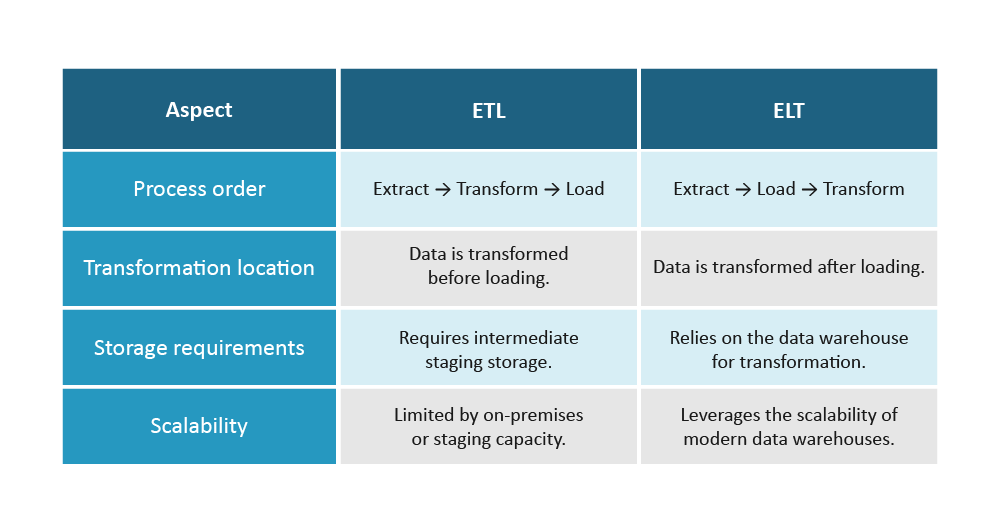
Both approaches aim to make data analysis ready, but their workflows cater to different needs and infrastructure capabilities.
When to choose ETL
ETL has been a go-to method for decades, particularly for businesses with legacy systems or strict compliance needs. Here’s when ETL might be the right fit:
- Highly structured data: ETL is ideal for structured data environments with clear schemas, like financial reporting systems.
- Compliance and security: Transforming data before it enters storage ensures sensitive information is processed securely.
- Limited infrastructure: If you rely on older systems that lack the power to process transformations at scale, ETL’s step-by-step approach keeps workloads manageable.
When to choose ELT
With the rise of cloud data warehouses (e.g., Snowflake, BigQuery), ELT has gained momentum. Its modern, scalable nature suits businesses looking for flexibility and speed.
- Large volumes of data: ELT can process massive datasets faster by skipping pre-storage transformations.
- Cloud-first environments: Cloud-native businesses benefit from the computing power of modern data warehouses.
- Agility for analysis: Analysts can work directly with raw data, applying transformations as needed for specific use cases.
Weighing the pros and cons of ETL vs ELT


Key questions to guide your decision
Still unsure which method to choose? Consider these guiding questions:
- What are your compliance requirements? If security and regulation are top priorities, ETL’s pre-load transformations offer greater control.
- How large and varied is your data? ELT shines when managing diverse and large datasets due to its scalability.
- What’s your infrastructure like? On-premises systems favor ETL, while cloud-first businesses benefit from ELT.
- Do you need real-time insights? ELT is typically better for real-time or near-real-time data scenarios.
How Netscribes enhances data processing
At Netscribes, we help businesses navigate the complexities of ETL vs ELT with tailored data integration solutions. Our expertise includes:
- Data consolidation and cleansing: We ensure consistency and accuracy by eliminating redundancies and errors.
- Data mapping and common models: By implementing effective mapping strategies, we provide clear insights for informed decision-making.
- ETL and ELT optimization: Whether your needs align with ETL or ELT, our team designs processes to maximize efficiency and scalability.
How Netscribes recommends choosing between ETL and ELT
Netscribes doesn’t start with a default answer. The recommendation depends on three things about the client’s situation:
- Cloud-first, analytics- or AI-led teams: ELT is usually the right default. Loading raw data first keeps it available for new use cases, and cloud platforms handle transformations at scale.
- Regulated industries handling sensitive data: In banking, insurance and healthcare, Netscribes typically recommends ETL, or at least a transform step before loading for sensitive fields. Personal or regulated data is masked or cleansed before it reaches shared storage.
- Enterprises partway through modernization: Most large organizations land on a hybrid. Legacy and on-premises sources keep ETL while they’re still running, and new cloud workloads move to ELT. The goal is a single governed platform, not a forced switch on every pipeline at once.
Whatever the approach, Netscribes supports it with data consolidation and cleansing, consistent mapping to common data models, and pipeline optimization for efficiency and scale.
Making the right choice for your business
The decision between ETL vs ELT boils down to your business goals, infrastructure, and data requirements. ETL is a tried-and-true approach for organizations with strict compliance needs or limited compute power, while ELT offers speed and scalability in cloud-first ecosystems.
Read more: The top data engineering trends shaping 2025
By understanding your unique needs, you can ensure your data integration strategy aligns with your growth trajectory.
Need help choosing the right approach for your business? Contact our data engineering services for a consultation, and let’s design a solution tailored to your data needs.
FAQs
Is ELT replacing ETL?
Not entirely. ELT has become the default for cloud-first analytics because modern data platforms can run transformations at scale after loading. ETL is still the better choice where sensitive data must be masked or cleansed before it’s stored, and on legacy or on-premises systems. Many enterprises run a hybrid, picking the approach workload by workload.
When should enterprises use ELT?
ELT fits best when data lands in a cloud data warehouse or lakehouse that has the computing power to run transformations, and when data volumes are large or varied. It’s also the stronger choice when analysts need raw data available to explore new questions, without waiting for engineering teams to rebuild transformations upstream.
Which cloud platforms support ELT natively?
Most major cloud data platforms are built for ELT, including Snowflake, Google BigQuery, Amazon Redshift, Databricks, and Microsoft’s Azure Synapse and Fabric. Each can load raw data and run transformations inside the platform using SQL or Spark, often with tools like dbt managing the transformation logic.