

Almost every CDO has fielded some version of the question: is the organization building a lakehouse? Most respond with a shrug, largely because the question tends to get treated as a technology refresh when it's really something bigger, a bet on the architecture the organization will be running three years from now, especially as AI takes on a larger role. Get that bet wrong, and unwinding it is costly. Get it right, and it opens up what the organization can build for years to come.
What Is a Data Lakehouse?
A data lakehouse merges the cost efficient, flexible storage of a data lake with the query speed, schema enforcement, and governance you'd normally associate with a data warehouse. Structured, semi-structured, and unstructured data all live together in one place, and both BI and AI/ML workloads run against that same underlying data instead of needing separate systems. Delta Lake, Apache Iceberg, and platforms such as Databricks are the technologies that have made this architecture workable at enterprise scale.
The Warehouse Hasn't Lost Its One Job
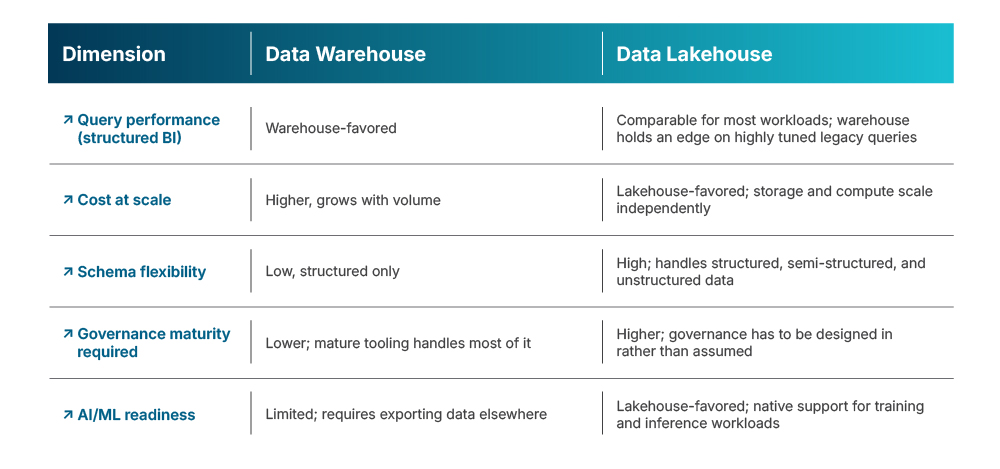
A data warehouse is built for structured data, tuned for fast and predictable queries against schemas that are locked down in advance. For regulated reporting, financial close cycles, and any workload where governance maturity and consistent query behavior outweigh flexibility, it's still the stronger option. Its ecosystem is well established, its tooling is familiar to most enterprise teams, and analysts can work in it without a learning curve. The cracks tend to show up only at scale: costs rise quickly with data volume because compute and storage are usually bundled rather than scaled separately, and rigid schemas struggle with the messier, less structured data that AI workloads increasingly need. None of that makes the warehouse obsolete, it just means it's a tool suited to a specific, well-defined job.
How the Lakehouse Came About
The lakehouse model emerged because enterprises kept hitting the same problem: a data lake was inexpensive but poorly governed, while a warehouse was governed but costly and inflexible. Teams ended up running both, shuttling data between them, and duplicating governance efforts in the process. Open table formats such as Delta Lake and Apache Iceberg gave lake storage the transactional guarantees and schema enforcement that used to be a warehouse's exclusive territory, which is what turned a single platform for both analytics and AI from a nice idea into something workable.
It's also worth noting that these two formats aren't the rival camps they were framed as even a couple of years back. Databricks now supports Apache Iceberg tables natively through Unity Catalog on top of its existing Delta Lake support, and the two ecosystems have been moving toward shared, interoperable standards rather than locking enterprises into one format for good. That convergence matters for anyone evaluating a lakehouse right now, it cuts down the format lock-in risk that made some organizations reluctant to commit a few years ago.
Where the Trade-offs Actually Sit
The question worth asking isn't which architecture is "better." It's which trade-offs your organization is prepared to live with.
When Sticking With the Warehouse Makes Sense
If BI and reporting make up most of the workload, if regulation demands strict schema governance, or if the current warehouse runs efficiently without straining its limits, staying put is often the sound call. Migrating architectures just for the sake of it, without a workload actually driving the change, tends to add cost and risk without much to show for it.
When the Lakehouse Pays Off
The case for a lakehouse strengthens as data grows messier and AI plans become more concrete. Multi-modal data, a mix of structured, semi-structured, and unstructured sources, fits naturally here. So does running AI/ML workloads and traditional analytics against the same data rather than maintaining two parallel pipelines. Cost pressure at high volume, and greenfield builds with no legacy warehouse to preserve, both push toward a lakehouse as well.
Why Many Enterprises End Up Running Both
In practice, a clean-cut either/or choice is rarer than it sounds. Plenty of enterprises hold onto a warehouse for governed BI and financial reporting while standing up a lakehouse alongside it for AI/ML workloads and raw data that won't fit a rigid schema. The architectural question that really matters here isn't warehouse versus lakehouse, it's where the line between them sits, and how data crosses it without governance work getting duplicated on both sides.
A common approach lets the lakehouse act as the system of record for raw and semi-structured data, while curated, business-critical tables get federated or replicated into the warehouse for reporting workloads that depend on its query performance and existing BI tooling. Get that boundary wrong, typically by letting both systems try to enforce the same governance rules independently, and a hybrid architecture tends to turn into two half-maintained platforms rather than one that actually works together.
Four Questions That Actually Settle This
Before locking in an architecture, it's worth answering four questions honestly. What does the workload mix look like today, and where is it trending? How mature is the team's data governance practice, and can it stretch to cover a less structured environment? What can the budget genuinely support, not just the migration itself, but the skills needed to run the new architecture well afterward? And how concrete is the AI roadmap, is this still an aspiration, or are there funded projects that need lakehouse-native data within the next year?
Choose Based on a Framework, Not a Trend
The right architecture is whichever one fits the workload, the team's governance maturity, and the AI roadmap the organization is actually funding, not whatever's trending in vendor marketing. Netscribes works with clients on both architectures and helps map out the migration path when a hybrid approach, rather than a full replatform, turns out to be the more realistic route. Book an architecture decision session with Netscribes
FAQs
1. What is the difference between a data lakehouse and a data warehouse?
A data warehouse stores structured data, optimized for BI queries. A data lakehouse stores every data type, structured, semi-structured, unstructured, and supports both analytics and AI/ML workloads on one platform.
2. Should I migrate from my data warehouse to a data lakehouse?
If significant AI/ML ambitions, multi-modal data, or cost pressure at scale are in the picture, yes, and sooner tends to beat later. If workloads are mostly structured BI, a warehouse may still be the right fit.
3. Is a data lakehouse cheaper than a data warehouse?
At scale, yes, and by a meaningful margin, storage costs drop sharply because lakehouses run on object storage, and compute scales independently. At smaller volumes, the cost gap barely matters.
4. Which is better for AI and machine learning: lakehouse or warehouse?
Lakehouse. AI and ML work needs access to raw, unstructured, and semi-structured data, which a lakehouse stores natively. Warehouses are built for structured queries, not model training pipelines.
5. What are the leading data lakehouse platforms in 2026?
Databricks Lakehouse Platform, Apache Iceberg on cloud storage, Delta Lake, and cloud-native builds on AWS (Glue + S3 + Lake Formation), Azure (ADLS + Synapse), and GCP (BigQuery + GCS)


