

Go-to-market intelligence is the research discipline that tells a company not just who it's competing against, but where those competitors are weakest, which segments they're underserving, which geographies they've deprioritized, and which price points they've left open. Competitive intelligence is one specific track inside that broader discipline: it answers where the openings are, rather than simply cataloguing who else is in the market. Most teams treat the two as the same exercise, which is exactly why they keep asking "who are our competitors?" when the far more useful question is "where are they not looking?" Whitespace, underserved segments, unoccupied price points, overlooked geographies, is where new entrants actually win. Finding it takes a different kind of research than reading competitor websites and building a slide.
Why Standard Competitive Analysis Isn't Enough for GTM Decisions
Most teams already know how to do this the familiar way: a feature comparison matrix, a SWOT built from secondary sources, a pass through competitor pricing pages. It's a reasonable starting point, and it's also where most internal competitive research stops.
Here's what it misses. A feature matrix tells you what a competitor has shipped, not what they're prioritizing next quarter. A SWOT built from public information tells you their stated strategy, not their actual go-to-market priorities or the roadmap signals sitting inside their hiring patterns, partner announcements, and regional investment. And none of it tells you the one thing a GTM decision actually needs: which customer segments a competitor is currently missing out on, and why.
That gap is structural, not a matter of trying harder. The information that reveals target segments, buyer sentiment, unmet needs, procurement friction, regional gaps in coverage, mostly doesn't live on a competitor's website. It lives with the buyers, operators, and specialists who deal with that competitor every day. Getting to it requires primary research, not another pass through public sources.
What Competitive Intelligence Looks Like Inside GTM Intelligence Services
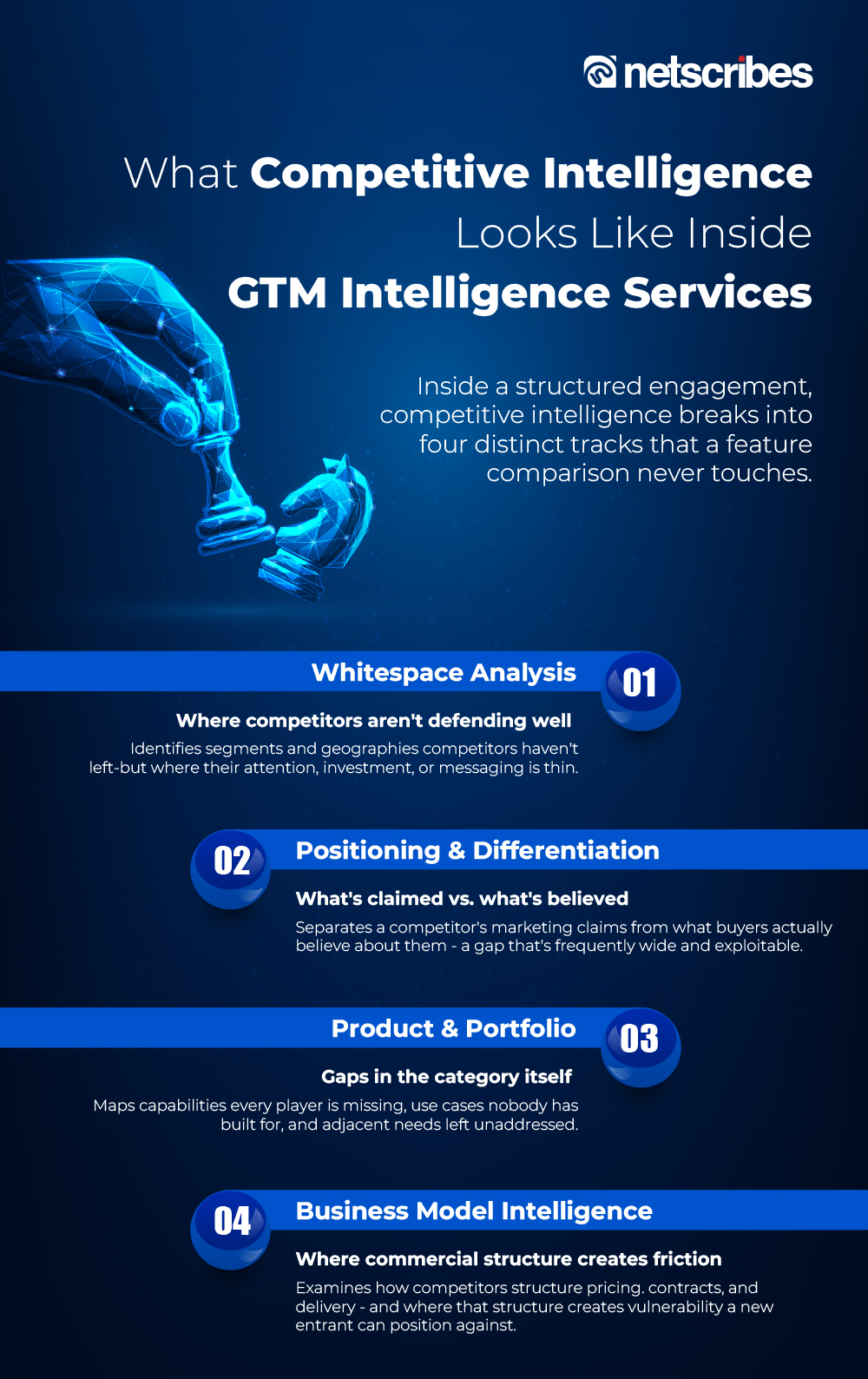
Inside a structured GTM intelligence services engagement, competitive intelligence breaks into a few distinct tracks that a feature comparison never touches:
Whitespace analysis identifies the segments and geographies competitors aren't defending well, not because they're absent, but because their attention, investment, or messaging is thin there. That being said, Whitespace is not only the segment where competition is not performing well. Primary research can unearth new segments, new opportunity areas, unmet needs, need gap analysis, all of these lead to understanding of the Whitespace.
Positioning and differentiation analysis separates what a competitor claims in its marketing from what buyers perceive about them, a gap that's frequently wide and frequently exploitable.
Product and portfolio analysis maps where the category itself has gaps: capabilities every player is missing, use cases nobody has built for, adjacent needs left unaddressed.
Business model intelligence looks at how competitors structure pricing, contracts, and delivery, and where that structure creates friction or vulnerability a new entrant can position against.
Put together, these four tracks answer a different question than a SWOT ever could: not "what does the competitor do," but "what has the competitor left on the table."
The Geography Dimension: Where Competitive Intelligence Changes the Entry Decision
Geography can completely change the logic of a GTM strategy. A global technology company evaluating Nigeria and the Democratic Republic of Congo needed more than a market-entry view; it needed a 10-year roadmap for emerging technology investments.
The study combined secondary research with qualitative and quantitative inputs from [X respondents] and [X expert interviews] across telecom operators, technology providers, regulators, and ecosystem stakeholders. Opportunities across AI, IoT/M2M, embedded SIM, and edge intelligence were assessed for market readiness, demand, competitive intensity, infrastructure needs, and partnership potential.
The research showed which opportunities were viable in the near term, which required ecosystem development, and where local partnerships would be critical. These insights were translated into a phased 10-year roadmap that helped the client prioritize markets, technologies, investment timing, and strategic partners.
The value was clear: not just understanding where opportunity existed, but knowing where to invest, when to enter, and with whom.
Competitive Intelligence by Geography: Capturing Local Market Nuances
For a molecular diagnostics company assessing the NGS landscape across Europe, China, and Japan, the challenge was not simply to build different strategies for different countries. It was to understand how buyer priorities, competitive strength, regulatory conditions, and adoption barriers varied within each geography.
The study combined 40 in-depth conversations with lab managers, bioinformaticians, and clinicians, supported by CATI and online research. Instead of treating each geography as a single homogeneous market, the analysis compared local purchasing criteria, incumbent strength, technology preferences, and regulatory influences across respondent groups and sub-markets.
This surfaced differences in which competitors were considered credible, what drove platform selection, and where adoption barriers were strongest. Those nuances helped the client identify market leaders more accurately, refine positioning by geography, and prioritize the customer groups and competitive battles that mattered most.
The value came from moving beyond country-level averages to understand the local conditions shaping adoption and competition.
How to Turn Competitive Intelligence Into a GTM Positioning Decision
None of this is useful as research for its own sake. The value shows up only when it moves through a specific chain: whitespace gets identified, a segment gets prioritized based on where the whitespace is real and reachable, positioning gets defined specifically against the competitors who are weak there, and messaging gets built to speak directly into that gap.
Skip a link in that chain and the research becomes a report that sits in a shared drive. The companies that treat competitive intelligence as an input to a positioning decision, not a deliverable in itself, are the ones who actually use it before launch, not after a competitor has already claimed the space.
The companies that enter markets and win are rarely the ones with the biggest budget. They're the ones who understood the competitive landscape, where it was weak, where it was crowded, and where it was simply unoccupied, before they committed to it.
If you're planning a market entry or category expansion and want to know where the whitespace actually is before you commit resources to a position, talk to Netscribes about GTM strategy research.
FAQs:
1. What is competitive intelligence for GTM?
It's the practice of monitoring competitors' pricing, positioning, and category coverage specifically to inform go-to-market decisions, not just general market awareness. For GTM, the goal is identifying where competitors are strong, where they're absent, and where a gap exists that a new entrant or new offering could capture.
2. What is whitespace analysis?
Whitespace analysis identifies segments, use cases, or categories where customer demand exists but no competitor has meaningful presence yet. It's the difference between competing head-on in a crowded segment and finding an underserved opening where a new product or service can establish position with less resistance.
3. How do you find whitespace before competitors do?
Combine competitive coverage mapping (where competitors are and aren't investing) with real demand signals (search behavior, unmet customer needs surfaced in research or support data) rather than relying on either alone. Whitespace that shows up in demand data but has no competitive presence yet is the strongest signal, and it disappears fast once a competitor notices it too.
4. Why does whitespace close so quickly once identified?
Once a genuine gap becomes visible, through market chatter, a competitor's earnings call, or simply increasing customer demand, other players tend to notice around the same time. The advantage typically goes to whoever moves first with a credible offering, which is why whitespace analysis works best as an ongoing monitoring practice rather than a one-time exercise.
5. How is this different from a standard competitive analysis?
A standard competitive analysis usually benchmarks your own position against competitors on existing categories. Whitespace-focused competitive intelligence looks specifically for what nobody is covering yet, it's forward-looking and gap-focused, rather than backward-looking and benchmark-focused


