

Most build-vs-buy conversations about data engineering start in the wrong place, with a vendor's pitch deck instead of an honest look at what's actually breaking in your team. The better starting point is a short list of signals that tell you, objectively, whether your current model can keep scaling or whether it's time to bring in outside capacity.
Below are five signals worth checking against your own team. Three of them point toward an extended, domain-matched team as the right answer. Two of them don't, and it's worth knowing which is which before you talk to any vendor, including us.
Signal 1: Your roadmap is growing faster than your hiring pipeline can fill seats
If your backlog of data engineering work keeps growing regardless of how many reqs you open, the bottleneck isn't ambition, it's throughput. Specialized data engineering roles commonly take 48 to 89 days to fill in the current U.S. market, depending on seniority and how niche the skill set is, and the fully loaded cost of a single hire (recruiting, interviewing, onboarding) is often estimated in the range of $200K or more once lost productivity is factored in. If every open seat represents months of delayed roadmap work, waiting for headcount to fill the traditional way is itself a cost, not a neutral, safe default.
Verdict: points toward an extended team. This is a velocity problem, and augmentation exists specifically to compress the time between "we need this built" and "someone is building it."
Signal 2: The engineers you can actually hire don't understand your data domain
Generalist data engineering talent is easier to find than domain-fluent talent. But a data engineer who has never worked inside BFSI transaction systems, retail inventory and POS data, or manufacturing IoT streams will spend real time — often months — learning your domain's specific data shapes, compliance constraints, and failure modes before they're producing at full speed. If your team keeps hiring strong generalists who then take a long runway to become useful on your specific data, that's a domain-fit problem, not a raw-talent problem.
Verdict: points toward an extended team, specifically a domain-matched one. This is the exact gap a generic augmentation vendor doesn't close, and where sector-specific experience (the core of Netscribes' Extended Data Teams model) earns its premium over a general staffing pool.
Signal 3: The work is ongoing and directed by your own roadmap, not a single bounded deliverable
If what you need is a continuous stream of pipeline builds, model iterations, and data-quality work that your own team prioritizes week to week, you need people who plug into your process, not a vendor who takes a spec and disappears for eight weeks. This is the difference between staff augmentation and project-based outsourcing: augmentation puts the engineer inside your management structure, taking direction from your leads and adjusting priorities as your roadmap shifts.
Verdict: points toward an extended team. Ongoing, roadmap-directed work is the natural fit for an augmentation or embedded-team model, not for a fixed-scope engagement.
Signal 4: What you actually need is a single, well-scoped project with a fixed deliverable
Not every gap should be filled with an extended team. If the need is genuinely bounded, a one-time data migration, a defined integration build, a specific pipeline with a clear finish line, a project-based outsourcing engagement, where the vendor owns delivery of that specific outcome, is usually the better fit. Embedding a long-term team into your management structure for a project with a hard end date adds coordination overhead you don't need.
Verdict: does not point toward an extended team. This is a case for scoped, outcome-owned outsourcing instead.
Signal 5: The capability is core, strategic, and you'll need it in-house for years
If the skill set in question is close to your core product or competitive differentiation, and you expect to need it permanently for the foreseeable future, the long-term answer is usually to build the capability in-house, full-time hires who accumulate institutional knowledge and stay invested in the outcome over years, not an engagement of any kind.
Verdict: does not point toward an extended team as the permanent answer, though an augmented or extended team can be the right bridge, covering the gap productively while your in-house hiring catches up, rather than leaving the work undone or improperly staffed in the meantime.
The five signals at a glance
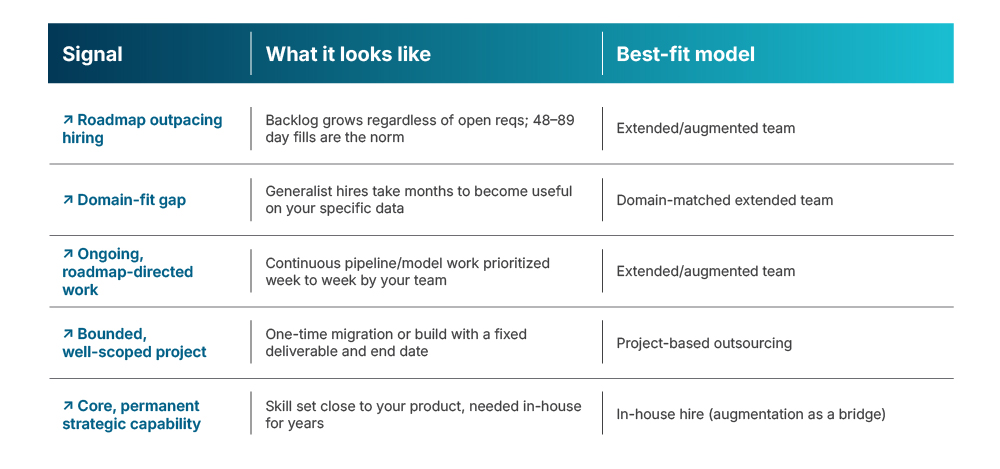
The honest takeaway
If you recognize your team in signals 1 through 3, an extended data engineering team, one matched to your specific domain rather than generically staffed, is very likely the right next move, and it's the gap Netscribes built Extended Data Teams to close. If you're squarely in signal 4 or 5, augmentation isn't the wrong tool because it's a bad model; it's the wrong tool for that specific job, and it's worth saying so plainly rather than stretching one model to fit every problem.
Most data organizations we talk to aren't purely one or the other, they have a mix of ongoing, domain-sensitive work (signals 1–3) alongside a few genuinely bounded projects (signal 4) and a core team they're still growing (signal 5). The right structure usually blends models rather than picking just one.
How Extended Data Teams work at Netscribes.
FAQs
1. When should you outsource data engineering?
Outsourcing (in the project-based sense) fits best when the work is a single, well-scoped deliverable with a fixed end date, a migration, a defined integration, a specific build. If the work is ongoing and needs to be directed by your own roadmap week to week, an extended or augmented team, not project-based outsourcing, is the better fit.
2. Should I outsource my data team?
It depends on which of the five signals above matches your situation. If your bottleneck is hiring speed, domain fit, or ongoing roadmap-directed capacity, an extended/augmented team is the stronger match than traditional outsourcing. If the need is a single bounded project, project-based outsourcing fits better. If the capability is core and permanent, building in-house is the long-term answer, with augmentation as a bridge in the meantime.
3. Build vs buy data engineering team, how do I decide?
Check your situation against five signals: hiring-pipeline lag, domain-fit gap, ongoing vs. bounded work, project scope, and how core/permanent the capability is. Three of the five (hiring lag, domain gap, ongoing roadmap-directed work) point toward an extended or augmented team. The other two (a bounded one-time project, or a core capability you'll need in-house for years) point toward project-based outsourcing or a direct hire instead


